



What's Happening?
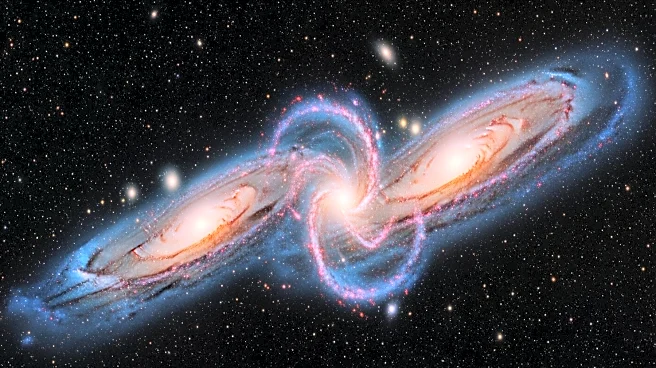
The James Webb Space Telescope (JWST), in collaboration with the Chandra X-ray Observatory, has captured a striking image of two colliding spiral galaxies, NGC 2207 and IC 2163, located 120 million light-years away in the constellation Canis Major. This
cosmic event, described as an 'intricate web of chaos,' showcases the gravitational interaction between the galaxies, which distorts their spiral arms and creates streams of stars and gas. The image combines midinfrared data from JWST, highlighting dust and cooler material, with X-ray data from Chandra, which reveals high-energy regions such as binary stars and supernova remnants. This observation is part of JWST's mission to provide insights into the centers of merging galaxies, aiding the development of new models for galaxy interactions.
Why It's Important?
This observation is significant as it enhances our understanding of galaxy formation and evolution. By studying the gravitational interactions and resulting star formation in colliding galaxies, scientists can refine models of how galaxies merge and evolve over time. The data from JWST and Chandra offer a detailed view of the high-energy processes occurring in these galaxies, contributing to our knowledge of cosmic phenomena such as star formation and supernovae. This research has implications for astrophysics, as it helps to unravel the complex dynamics of galaxy interactions, which are fundamental to the structure and evolution of the universe.
What's Next?
Future observations by JWST and other telescopes will continue to focus on similar cosmic events to further understand the processes involved in galaxy mergers. These studies will likely lead to more detailed models of galaxy evolution and may uncover new phenomena associated with these interactions. The ongoing analysis of data from JWST and Chandra will also contribute to the broader field of astrophysics, potentially leading to new discoveries about the universe's history and structure.
Beyond the Headlines
The collaboration between JWST and Chandra highlights the importance of multi-wavelength astronomy, where different types of light are used to gain a comprehensive understanding of cosmic events. This approach allows scientists to observe various aspects of astronomical phenomena, providing a more complete picture of the universe. The study of colliding galaxies also raises questions about the fate of our own galaxy, the Milky Way, which is expected to collide with the Andromeda galaxy in the distant future. Understanding these processes can offer insights into the long-term future of our galaxy and its potential transformations.