






What's Happening?
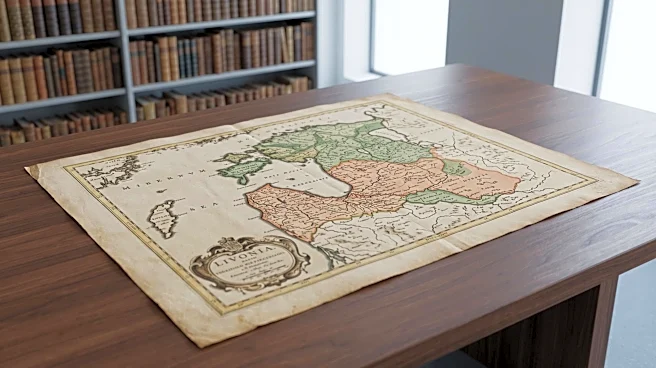
The GDELT Project has successfully employed Gemini artificial intelligence to determine the precise date of a mid-17th-century Estonian map, Johannes Janssonius' 'Nova Totius Livoniae Accurata Descriptio.' This particular map has at least 13 known editions,
or 'states,' published between 1636 and 1658. To date such historical maps, researchers typically rely on map state tables found in reference works, which differentiate editions based on verso text, including language, page number, and signature. The GDELT Project provided Gemini with photos of the map's front and back, along with a cellphone snap of the relevant page from Koeman's Atlantes Neerlandici, a key reference work. Gemini was able to visually cross-reference the map's features and verso text against the state table, accurately identifying the map's date as between 1646 and 1657.
Why It's Important?
This application of Gemini AI by the GDELT Project represents a significant advancement in historical cartography and digital humanities. Traditionally, dating historical maps with multiple editions is a meticulous and time-consuming process requiring specialized expertise in cartographic history and paleography. By leveraging AI, researchers can automate and accelerate this process, making historical archives more accessible and research more efficient. This technology can help museums, libraries, and academic institutions to more accurately catalog and understand their collections, potentially uncovering new insights from previously undated or misidentified artifacts. The ability of AI to interpret complex visual and textual information from historical documents opens new avenues for research and preservation.
What's Next?
The GDELT Project's successful use of Gemini suggests a broader potential for AI in analyzing and interpreting historical documents. Future applications could include dating other types of historical texts, identifying variations in printed editions, or even transcribing ancient manuscripts. Museums and archives may increasingly adopt AI tools to assist in cataloging, conservation, and research efforts, particularly for large collections where manual analysis is impractical. This could lead to the development of specialized AI models trained on specific types of historical data, further enhancing the accuracy and efficiency of historical research. The project's findings also highlight the growing collaboration between AI technology and traditional academic disciplines.
Beyond the Headlines
The integration of AI into historical research raises intriguing questions about the future of scholarship. While AI can significantly streamline data processing and identification, the interpretive and contextual understanding of historical artifacts will likely remain a human endeavor. This collaboration between human expertise and artificial intelligence could lead to a new paradigm in historical studies, where AI acts as a powerful assistant, enabling scholars to focus on deeper analysis and broader historical narratives. Furthermore, the ability of AI to process vast amounts of historical data could help uncover previously unnoticed patterns or connections, leading to novel interpretations and a richer understanding of the past. This development underscores the transformative potential of AI across various academic fields.