







What's Happening?
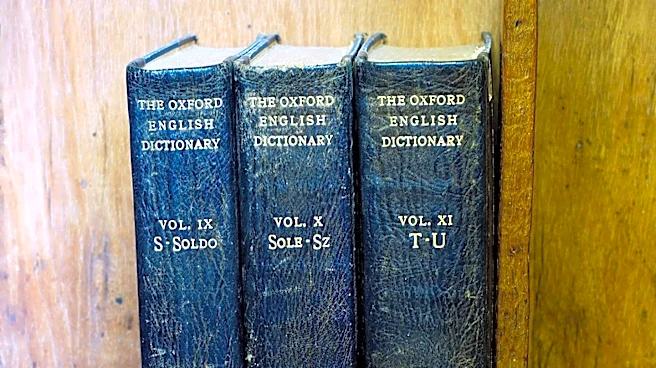
The Oxford English Dictionary (OED) has officially recognized over a dozen words commonly used in Bermuda and across the Caribbean. This inclusion acknowledges the unique linguistic contributions of these regions. Among the newly added terms is 'bimpert,'
a Bermudian word of unknown origin used to describe a foolish person, often in the phrase 'A bimpert is justah wuffless bye.' Another notable addition is 'hornerman,' a term from Trinidad and Tobago, used since 1975 to describe an unfaithful man. The dictionary also includes phrases like 'to get on,' meaning to have an emotional outburst, and 'to cut someone’s tail,' meaning to beat someone. Financial terms such as 'vex money,' referring to emergency funds for women, have also been recognized. Supernatural elements are represented by 'jablesse,' a malevolent shape-shifting female spirit, and 'douen,' the spirit of an unbaptized child. Food-related words like 'shadeesh' (Bermudian chorizo), 'sugar cake,' and 'peanut punch' are now part of the OED. Additionally, terms of address like 'nana' or 'nani' (Hindi words for maternal grandparents) and 'chamma' (Bermudian for friend) have been included. The OED also added 'Trinbagonian,' referring to people from Trinidad and Tobago, and 'canboulay,' which describes Carnival festivities in Trinidad that commemorate the emancipation of slaves.
Why It's Important?
The inclusion of these words in the Oxford English Dictionary is a significant recognition of the rich cultural and linguistic heritage of the Caribbean and Bermuda. For residents of these regions, it validates their unique expressions and traditions, which have often been marginalized in global linguistic discourse. As Leonard Alexander, a grocery store owner in Trinidad, noted, these words are part of their heritage and upbringing, and their formal recognition helps share this with the wider world. Avionne George, a maintenance technician in Trinidad, highlighted that this helps preserve tradition for younger generations who might be unfamiliar with older terms. The OED's acknowledgment can foster a greater understanding and appreciation of Caribbean and Bermudian cultures globally, promoting linguistic diversity. It also underscores the dynamic nature of language, demonstrating how regional dialects contribute to the evolution of English. This move can empower communities by affirming their cultural identity and encouraging the continued use and documentation of their unique vocabulary. Sherwin Williams, a construction worker in Trinidad, emphasized that this helps people worldwide understand Trinidadian origins, as 'People recognize us by our slang.'
What's Next?
The formal inclusion of these words in the Oxford English Dictionary is likely to lead to increased awareness and usage of these terms beyond their originating regions. Educators and linguists may incorporate these new entries into their studies, further enriching academic understanding of creole languages and their influence on English. The recognition could also inspire other lexicographical efforts to document and preserve regional dialects and unique linguistic expressions from various parts of the world. For the communities in Bermuda and the Caribbean, this validation may encourage a renewed sense of pride in their linguistic heritage, potentially leading to more initiatives aimed at cultural preservation and education. It could also spark further interest in the etymology and historical context of these words, fostering deeper cultural exploration. The OED's ongoing process of adding new words suggests that more regional terms may be considered for inclusion in the future, reflecting the continuous evolution of the English language through global contributions.
Beyond the Headlines
The addition of Caribbean and Bermudian words to the Oxford English Dictionary extends beyond mere linguistic recognition; it carries significant cultural and historical weight. Many of these words, such as 'canboulay,' are deeply intertwined with the history of emancipation and resistance, offering insights into the struggles and triumphs of these communities. 'Canboulay,' derived from 'burning cane,' is associated with acts of defiance and rebellion, highlighting the historical context of Carnival festivities. The inclusion of terms like 'jablesse' and 'douen' also sheds light on the rich folklore and spiritual beliefs prevalent in these cultures, providing a window into their unique worldviews. This move by the OED can be seen as a step towards decolonizing language, acknowledging that English is not a monolithic entity but a vibrant, evolving language shaped by diverse global influences. It challenges the traditional Eurocentric view of language and promotes a more inclusive understanding of its development. This recognition can also foster a sense of belonging and representation for individuals from these regions, affirming their cultural identity on a global stage and encouraging a broader appreciation for the diversity within the English language.