



What's Happening?
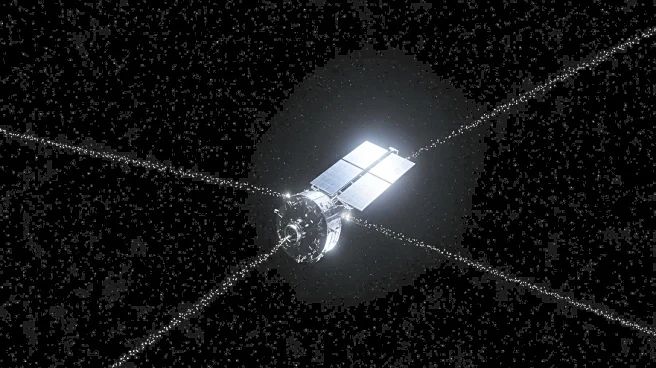
A decommissioned Russian signals intelligence satellite, known as Luch/Olymp, disintegrated in orbit on January 30, 2026, following a suspected collision with space debris. The incident was captured by Swiss space monitoring firm S2A Systems using ground-based
optical sensors. The satellite, which had been operating in a graveyard orbit—a region considered safe for retired spacecraft—broke apart, creating additional debris. Astrophysicist Jonathan McDowell suggested that the collision was likely caused by a debris strike rather than an internal malfunction, highlighting the increasing risk of debris in high-altitude orbits. The Luch/Olymp satellite, linked to Russia's Federal Security Service, was decommissioned and moved to the graveyard orbit in October 2025.
Why It's Important?
The destruction of the Luch/Olymp satellite underscores the growing threat of space debris in high-altitude orbits, which were previously considered low-risk. This event raises concerns about the safety of graveyard orbits, where retired satellites are placed to avoid collisions with active satellites. The accumulation of debris in these regions could lead to a cascading effect, where collisions generate more fragments, increasing the risk of further collisions. This poses a significant challenge for space agencies and satellite operators, as it could impact the safety and sustainability of space operations, including telecommunications and weather monitoring.
What's Next?
The incident may prompt a reevaluation of current space debris management practices and the safety of graveyard orbits. Space agencies and satellite operators might need to enhance tracking and monitoring of debris in high-altitude orbits to prevent future collisions. Additionally, international cooperation could be necessary to develop strategies for debris mitigation and removal, ensuring the long-term sustainability of space activities. The event could also lead to discussions on updating guidelines for satellite decommissioning and the use of graveyard orbits.
Beyond the Headlines
The fragmentation of the Luch/Olymp satellite highlights the broader issue of space security and the potential for geopolitical tensions in space. As more countries develop and deploy satellites for military and intelligence purposes, the risk of accidental or intentional collisions increases. This incident may prompt discussions on the need for international agreements to regulate space activities and prevent conflicts. Furthermore, the growing debris problem could accelerate the development of new technologies for debris removal and collision avoidance, fostering innovation in the space industry.