
What's Happening?
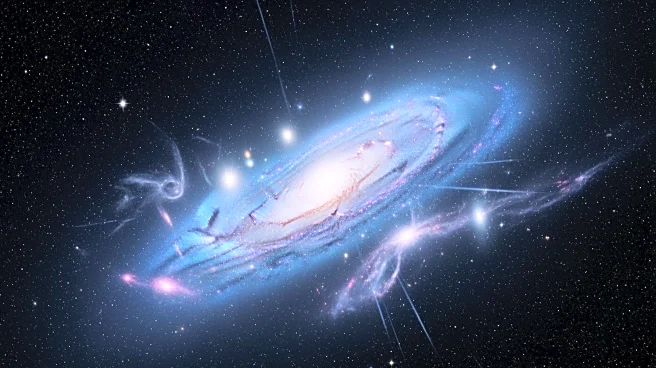
The James Webb Space Telescope has confirmed the existence of a galaxy, MoM-z14, which existed 280 million years after the Big Bang. This discovery pushes the boundaries of the observable universe closer
to cosmic dawn. The galaxy's light has been traveling for about 13.5 billion years, providing insights into the early universe's conditions. The galaxy is noted for its unusual nitrogen enrichment, suggesting the presence of supermassive stars in the early universe. This finding challenges existing theories about the formation and evolution of galaxies shortly after the Big Bang.
Why It's Important?
The confirmation of MoM-z14 provides critical data for understanding the early universe's conditions and the formation of galaxies. It challenges current theoretical models, which did not predict such high levels of nitrogen or the existence of such bright galaxies so soon after the Big Bang. This discovery could lead to revisions in our understanding of stellar evolution and the processes that governed the early universe. It also highlights the capabilities of the James Webb Space Telescope in uncovering new cosmic phenomena, potentially leading to further groundbreaking discoveries.
What's Next?
Future observations with the James Webb Space Telescope will continue to explore the early universe, potentially uncovering more galaxies like MoM-z14. These findings will be crucial for refining models of the universe's evolution and understanding the role of supermassive stars in the early cosmos. Researchers will also focus on the timeline of reionization, a period when early stars began to illuminate the universe, providing further context for these discoveries.