



What's Happening?
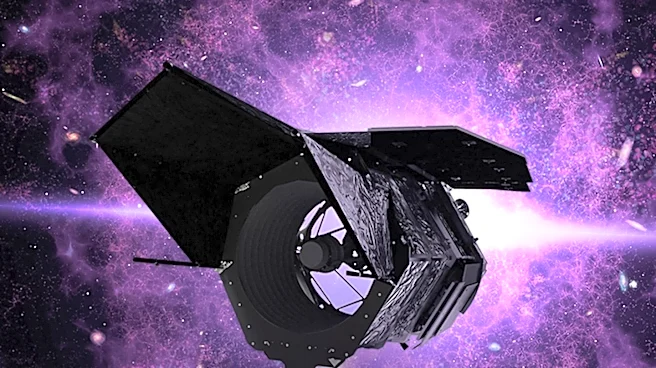
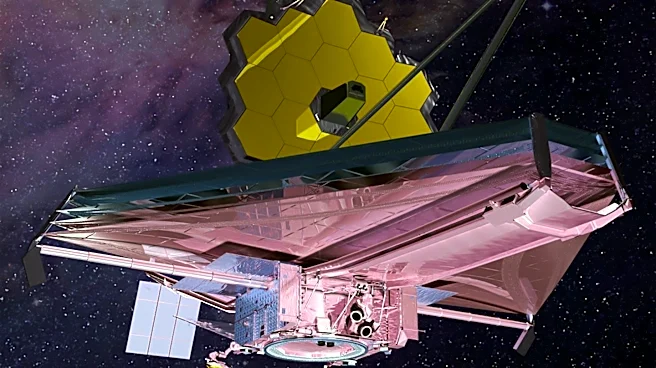
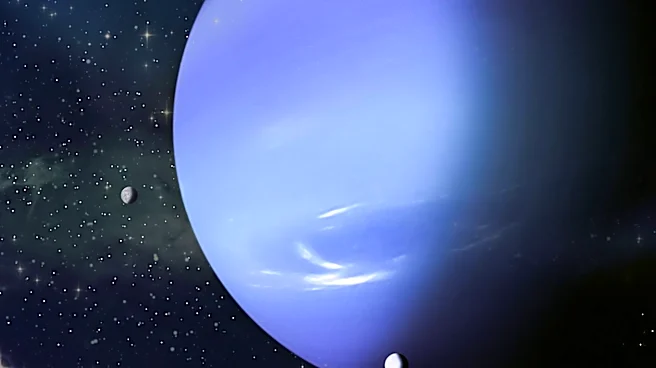
Recent observations using NASA's James Webb Space Telescope have provided new insights into Neptune's inner moons, suggesting they may be the remnants of ancient icy worlds. The study, conducted by Caltech researchers, focused on the moons Larissa, Galatea,
and Proteus, revealing unique compositions that differ from other outer solar system bodies. The findings suggest that Neptune once had a system of moons that was destroyed when Triton, its largest moon, was captured by the planet's gravity. The remnants from this event likely coalesced to form the current inner moons. This research, published in Science Advances, highlights the complex history of Neptune's satellite system.
Why It's Important?
The discovery of Neptune's inner moons as remnants of ancient icy worlds provides significant insights into the planet's evolutionary history and the dynamics of its satellite system. Understanding these processes can offer broader implications for planetary formation and the behavior of celestial bodies in the outer solar system. The study also highlights the capabilities of the James Webb Space Telescope in uncovering details about distant planetary systems, which could lead to further discoveries about the formation and evolution of other planets and their moons.
What's Next?
Future research may focus on the dynamics of the moon-destruction and recreation process, exploring how Triton's capture influenced the evolution of Neptune's satellite system. Scientists may also investigate the initial size and composition of the original moons to better understand the materials present in Neptune's current moons. These studies could provide further insights into the processes that shape planetary systems and the potential for similar events in other parts of the solar system.