






What's Happening?
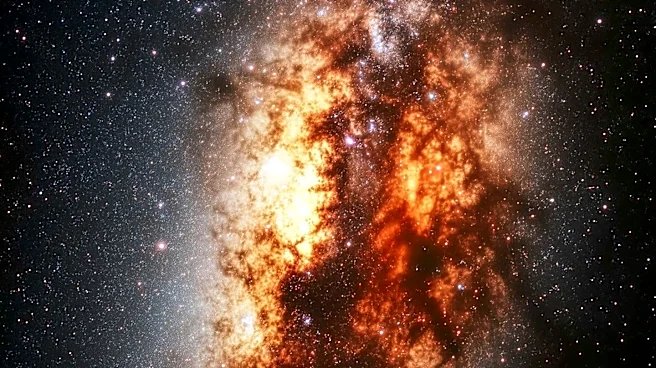
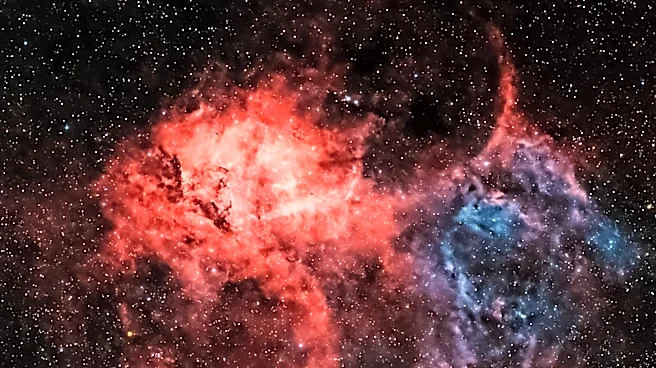
Astrophysicists, led by Kathryn Kreckel from Heidelberg University, have redefined the Galactic Center Lobe (GCL), a structure previously thought to be a massive feature emanating from the Milky Way's core. The GCL, once believed to be a remnant of a supermassive
black hole, is now identified as a closed loop located approximately 6,520 light-years from Earth. This discovery suggests that the GCL is not a towering structure but rather a bubble of material shaped by stellar activity. The research, published in Astronomy & Astrophysics, utilized data from the SDSS-V Local Volume Mapper survey, which provided detailed maps of glowing gas within the Milky Way. The study revealed that the GCL is a vast cloud of hydrogen gas glowing under ultraviolet radiation, likely carved by massive stars from a previous generation.
Why It's Important?
This discovery challenges previous assumptions about the structure and dynamics of the Milky Way's core. By identifying the GCL as a closer and smaller structure, the research provides new insights into the processes shaping our galaxy. This finding could influence future studies on galactic formations and the role of stellar activity in shaping cosmic structures. The reclassification of the GCL also highlights the complexity of observing and interpreting astronomical phenomena, emphasizing the need for advanced observational techniques and data analysis. This could lead to a better understanding of similar structures in other galaxies, potentially impacting theories on galaxy evolution and star formation.
What's Next?
Future research will likely focus on identifying the specific stars responsible for shaping the GCL. Understanding the origins and development of such structures could provide further insights into the lifecycle of stars and the formation of galactic features. Additionally, the methodologies used in this study may be applied to other cosmic phenomena, potentially leading to new discoveries about the Milky Way and beyond. As astronomers continue to refine their techniques, more hidden structures within our galaxy may be uncovered, offering a deeper understanding of the universe's complexities.
Beyond the Headlines
The redefinition of the GCL underscores the challenges faced by astronomers in measuring distances and interpreting data from densely populated regions of space. This case illustrates the importance of using multiple observational methods to gain a comprehensive understanding of cosmic phenomena. The study also highlights the potential for misinterpretation when relying solely on radio images, as the GCL's appearance was significantly altered by its backdrop. This finding may encourage the development of new technologies and methods to overcome similar observational challenges in the future.