







What's Happening?
Mikela Kendrick, a 24-year-old woman from Byron, Georgia, has pleaded guilty to one count of conspiracy to commit bank fraud in a federal court. According to the U.S. Attorney’s Office for the Middle District of Georgia, Kendrick was involved in a scheme
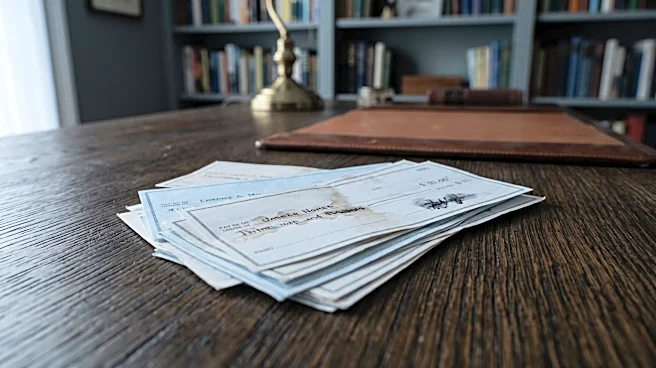
that utilized stolen checks with a total face value exceeding hundreds of thousands of dollars. Between August 2024 and September 2025, Kendrick and an accomplice obtained checks stolen from the mail. They then employed a technique known as 'check washing' to alter the payee's name and the dollar amount on these checks. Kendrick subsequently advertised and sold these altered checks through social media. Law enforcement officers, during a search warrant executed at her home in September 2025, discovered 112 stolen personal and business checks, money orders, and cashier’s checks, totaling $395,101.43. They also found blank check stock, bank cards, identification cards with various names, printers, and other supplies used for check alteration.
Why It's Important?
This case highlights the persistent threat of mail theft and bank fraud to U.S. citizens and businesses, underscoring the vulnerability of traditional financial instruments to sophisticated criminal schemes. The use of 'check washing' and social media for illicit transactions demonstrates the evolving methods criminals employ to exploit financial systems. The prosecution of individuals like Mikela Kendrick is crucial for deterring similar activities and protecting the integrity of the banking sector. The significant financial value of the stolen checks, nearly $400,000, indicates the potential for widespread financial damage to victims, including individuals and small businesses. This case also emphasizes the importance of inter-agency cooperation among law enforcement bodies, such as the U.S. Postal Service Office of Inspector General and local sheriff's offices, in combating financial crimes.
What's Next?
Mikela Kendrick faces severe penalties, including up to 30 years in federal prison, five years of supervised release, and a $1 million fine. Her sentencing date has not yet been scheduled by U.S. District Judge C. Ashley Royal. This prosecution is part of a broader effort by the U.S. Attorney’s Office to combat mail theft and bank fraud, with this being the second such federal prosecution in a short period. Law enforcement agencies are expected to continue their vigilance against these types of crimes, focusing on identifying, investigating, and prosecuting those who prey on the public through financial deception. The outcome of Kendrick's sentencing will likely serve as a deterrent and reinforce the legal consequences for engaging in such fraudulent activities.
Beyond the Headlines
The 'check washing' scheme employed in this case reveals a low-tech yet effective method of financial fraud that can bypass some digital security measures. The use of social media to advertise and sell altered checks also points to the dark side of online platforms, which can be exploited for criminal enterprises. This incident underscores the need for both individuals and financial institutions to remain vigilant against mail theft and to adopt secure practices for handling financial documents. It also raises questions about the responsibility of social media platforms in monitoring and preventing the use of their services for illegal activities. The long-term implications include a potential increase in public awareness campaigns about mail security and enhanced collaboration between tech companies and law enforcement to combat online financial crime, ultimately aiming to safeguard consumers and businesses from such illicit operations.