





What's Happening?
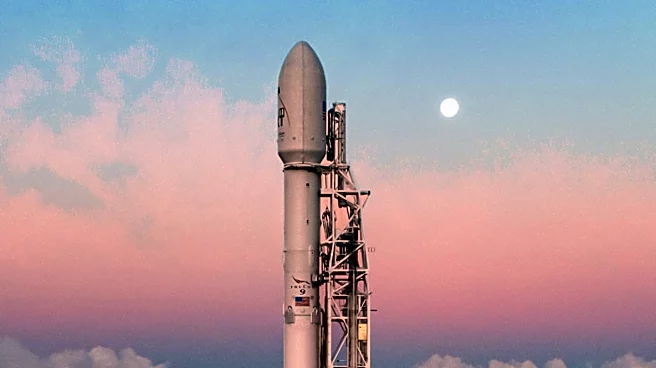
SpaceX successfully launched three O3b mPOWER telecommunications satellites for Luxembourg-based SES, marking the 700th mission for its Falcon rocket family. The Falcon 9 rocket lifted off from Florida's Cape Canaveral Space Force Station, deploying the final
satellites to complete SES' O3b mPOWER constellation. This mission included the 29th flight for the Falcon 9's first stage booster, which successfully landed on the drone ship 'A Shortfall of Gravitas' in the Atlantic Ocean. The satellites were deployed into medium Earth orbit (MEO) at an altitude of 5,000 miles, completing a constellation designed to provide low-latency, high-throughput connectivity for various industries.
Why It's Important?
This milestone launch underscores SpaceX's dominant role in the commercial space industry and its rapid pace of operations. The completion of the O3b mPOWER constellation is crucial for global telecommunications, enhancing internet connectivity and data services for industries requiring reliable, low-latency communication. The reusability of the Falcon 9 booster, demonstrated by its 29th flight, highlights the economic and environmental benefits of SpaceX's approach to spaceflight, significantly reducing launch costs and increasing mission frequency. This achievement further solidifies the U.S.'s leadership in space technology and its capacity to support critical global infrastructure through private enterprise, impacting sectors from maritime to government services.
What's Next?
With the O3b mPOWER constellation now complete, SES will focus on integrating these new satellites into its existing network to expand and enhance its global connectivity services. SpaceX is expected to continue its aggressive launch schedule, further pushing the boundaries of rocket reusability and mission frequency. The company's ongoing development of its Starship program, alongside its Falcon family operations, suggests a future with even more ambitious space endeavors, including lunar and Martian missions. This continuous innovation will likely drive further advancements in satellite technology, space exploration, and the commercialization of space, impacting various industries and scientific research globally.
Beyond the Headlines
The 700th Falcon mission signifies more than just a numerical milestone; it represents a paradigm shift in space launch capabilities. SpaceX's relentless pursuit of reusability has not only made space access more affordable but has also challenged traditional aerospace manufacturing and operational models. This success story has broader implications for national security, scientific research, and the burgeoning space economy, fostering competition and innovation across the globe. The increasing number of satellites in orbit, while beneficial for connectivity, also raises concerns about space debris and orbital traffic management, prompting international discussions on sustainable space practices. The long-term impact of such frequent launches will shape humanity's presence in space and its ability to leverage orbital assets for Earth-based applications.