
What's Happening?
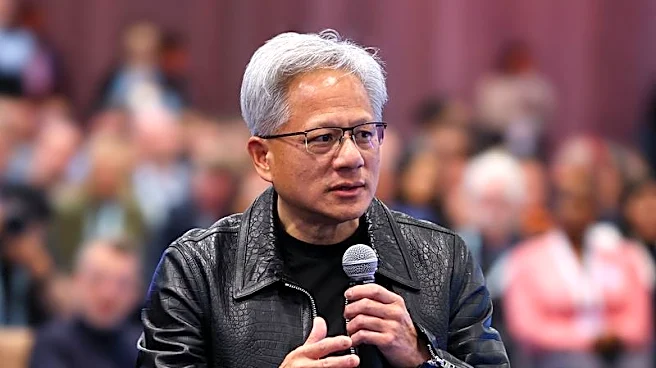
Nvidia CEO Jensen Huang, in a New York Times interview with Ezra Klein, discussed the implications of artificial intelligence on education, particularly concerning mathematical proficiency. Huang acknowledged
research from China indicating that while AI tools facilitate faster homework completion for students, their quiz and test scores subsequently decline, suggesting a drop in retention. Despite this, Huang expressed a view that the diminishing importance of basic math skills, such as long division, multiplication tables, and square roots, is not a crisis. He posited that many skills are becoming obsolete in the age of AI and that society will naturally adapt by identifying new essential competencies, while some existing skills will retain their relevance. Huang shared personal anecdotes, including forgetting his own address and phone number, to illustrate his point that not all skills are crucial for modern life.
Why It's Important?
This perspective from a leading figure in the AI industry carries significant weight for the future of U.S. education and workforce development. If basic mathematical proficiency is indeed deemed less critical due to AI, it could lead to a fundamental re-evaluation of educational curricula and teaching methodologies across the nation. The potential shift away from foundational math skills could impact STEM fields, potentially altering the skill sets required for future engineers, scientists, and technologists. While AI can perform complex calculations, the human capacity for reasoning, problem-solving, and understanding underlying mathematical principles remains vital. A decline in these foundational skills could create a generation less equipped to critically analyze AI outputs or innovate beyond current technological capabilities. This debate highlights a growing tension between leveraging AI for efficiency and preserving essential human cognitive abilities.
What's Next?
The discussion initiated by Jensen Huang's comments is likely to spark further debate among educators, policymakers, and technology leaders regarding the role of AI in learning and the necessary evolution of educational standards. Schools and universities may face increasing pressure to integrate AI tools into their curricula while simultaneously addressing concerns about skill retention and critical thinking. There could be a push to redefine what constitutes 'basic' or 'essential' knowledge in an AI-driven world, potentially leading to new educational frameworks that emphasize 'systems thinking' or other higher-order cognitive skills over rote memorization or manual calculation. The long-term impact on student performance and the preparedness of the future workforce will be closely monitored, with potential adjustments to educational policies and funding priorities.
Beyond the Headlines
Beyond the immediate educational implications, Huang's remarks touch upon deeper philosophical questions about human intelligence, the nature of knowledge, and our reliance on technology. The idea that certain cognitive skills can be outsourced to AI raises ethical considerations about the potential for intellectual atrophy and the definition of human capability. If society increasingly relies on AI for basic tasks, there's a risk of losing the cognitive benefits associated with mastering those tasks, such as enhanced problem-solving abilities and logical reasoning. This shift could also exacerbate digital divides, as access to advanced AI tools might become a determinant of educational and professional success. The conversation extends to how humans will interact with and understand a world increasingly mediated by AI, and whether a foundational understanding of how these systems work, including their mathematical underpinnings, will become more, not less, important.