
What's Happening?
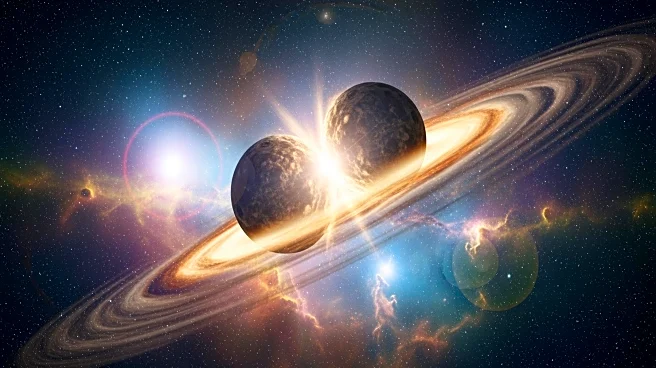
Astronomers have discovered that what appeared to be a planet around the star Fomalhaut was actually the result of a massive space collision. The event, observed in 2004 and again in 2023, involved two
large bodies colliding, creating a dust cloud that mimicked the appearance of a planet. This finding suggests that such collisions may be more common during planet formation than previously thought. The study, led by Paul Kalas from the University of California, Berkeley, used data from the Hubble Space Telescope to analyze the debris around Fomalhaut, a young star located 25 light years from Earth.
Why It's Important?
This discovery challenges existing theories about planet formation and the frequency of large collisions in young star systems. Understanding these events provides insights into the early stages of planetary system development and the conditions that lead to planet formation. The findings also highlight the need for caution in interpreting astronomical observations, as dust clouds can masquerade as planets. This research could influence future exoplanet studies and the development of new observational techniques to distinguish between planets and other celestial phenomena.
What's Next?
Astronomers plan to continue monitoring the Fomalhaut system using the James Webb Space Telescope and the Hubble Space Telescope to observe changes in the dust cloud over time. These observations will help refine models of planet formation and improve the ability to identify true exoplanets. The study also underscores the importance of developing more advanced telescopes and instruments to enhance the accuracy of astronomical observations and expand our understanding of the universe.