









What's Happening?
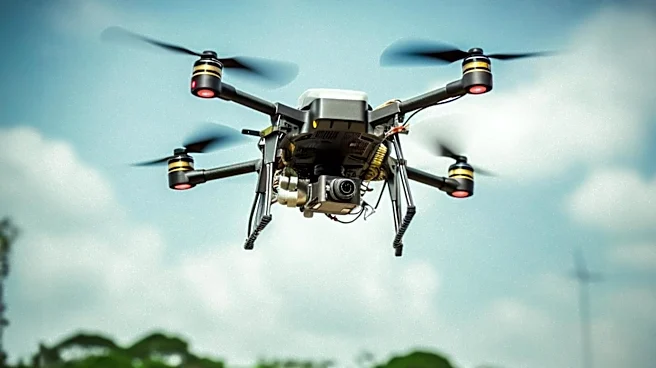
Teledyne FLIR Defense has introduced the Black Recon Autonomous Micro-Drone, a new unmanned aerial vehicle (UAV) designed for military reconnaissance, surveillance, and target acquisition (RSTA) tasks. The drone, unveiled at Eurosatory 2026 in France,
is intended for integration with military vehicles, allowing crews to launch, operate, recover, and recharge the UAV without leaving their platform. The Black Recon system features a three-UAV rotation concept, providing near-continuous overwatch with both electro-optical and thermal imaging capabilities. It is equipped with advanced sensors for Global Navigation Satellite System-denied environments and can conduct radio-silent missions. The drone's autonomy features reduce operator workload through automatic route generation and onboard detection, supporting activities such as area search, tracking, and monitoring.
Why It's Important?
The introduction of the Black Recon Autonomous Micro-Drone represents a significant advancement in military surveillance technology, offering enhanced capabilities for reconnaissance and target acquisition. This development is crucial for modern military operations, where real-time intelligence and reduced personnel exposure are paramount. The drone's ability to operate autonomously and provide continuous surveillance can improve decision-making and operational efficiency. Additionally, its potential applications in public safety and security roles, such as law enforcement and border protection, highlight its versatility and broader impact on national security. The integration of such advanced UAVs could lead to shifts in military strategy and resource allocation, emphasizing the growing importance of unmanned systems in defense.
What's Next?
As the Black Recon drone becomes operational, military units are likely to integrate it into their existing surveillance and reconnaissance frameworks. This could lead to further developments in autonomous UAV technology and its applications in various military and security contexts. Stakeholders, including defense contractors and military strategists, may explore additional enhancements and mission modules to expand the drone's capabilities. The broader adoption of such technology could also prompt discussions on regulatory and ethical considerations surrounding autonomous surveillance systems, particularly in terms of privacy and data security.