





What's Happening?
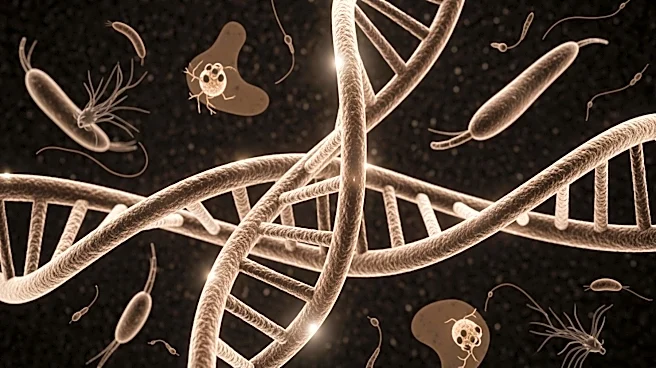
A comprehensive study led by researchers from the Okinawa Institute of Science and Technology and the University of Oxford has uncovered the significant role of horizontal gene transfer (HGT) in the evolution of osmotrophic decomposers. These organisms,
including fungi and other eukaryotes, play a crucial role in nutrient recycling by breaking down organic matter. The study, published in Nature Ecology and Evolution, reveals that HGT has been a driving force in the development of osmotrophic specialization across four distinct groups: Fungi, Pseudofungi, Labyrinthulea, and Teretosporea. This research challenges the traditional view that gene transfer is primarily a bacterial phenomenon, highlighting its impact on eukaryotic evolution.
Why It's Important?
The findings of this study have profound implications for understanding the evolution of complex traits in eukaryotes. By demonstrating that HGT has significantly influenced the development of osmotrophic mechanisms, the research suggests that gene flow is a powerful evolutionary force shaping biodiversity and ecosystem functionality. This insight could lead to new approaches in biotechnology and environmental management, as well as a deeper understanding of microbial ecology. The study also emphasizes the need to reconsider the evolutionary processes that contribute to the adaptation and survival of organisms in diverse ecological niches.
What's Next?
Future research will focus on validating the functional roles of the horizontally acquired genes identified in the study. This will involve experimental studies to examine gene expression and protein activity, potentially uncovering new targets for biotechnological applications. Additionally, the study opens up new avenues for exploring the mechanisms of HGT in eukaryotes, which remain largely enigmatic. Understanding these processes could lead to breakthroughs in evolutionary biology and the development of innovative strategies for harnessing eukaryotic diversity.