


What's Happening?
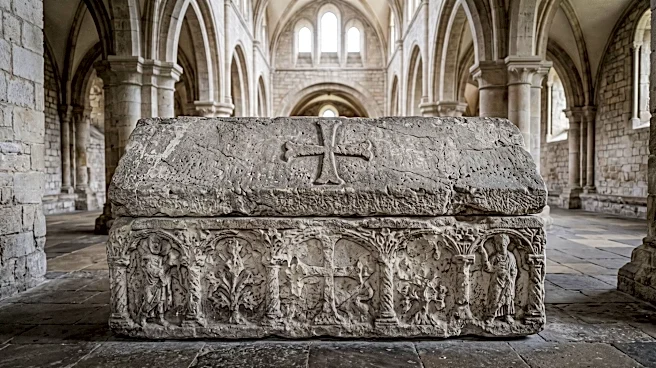
After more than 150 years, archaeologists believe they have identified the likely occupant of a Roman sarcophagus discovered at Westminster Abbey. Consultant archaeologist Warwick Rodwell conducted a new analysis of the remains, concluding that the coffin's
occupant was probably a medieval monk or abbot of Westminster. The sarcophagus itself dates to the Roman period, around the fourth century, and was originally dedicated to Valerius Amandinus. However, a late Anglo-Saxon style cross carved on the lid, made at least 600 years later, indicated the skeleton was not the original Roman occupant. The bones, found in disarray after being disturbed during earlier excavations in 1820 and 1869, were radiocarbon dated to between A.D. 987 and 1052. Skeletal analysis suggests the individual was a man who died between 35 and 49 years old. The discovery of a lime patch within the sarcophagus, a practice rare in the Middle Ages and reserved for high-status burials, further supported the theory of an important figure. Rodwell reported his findings on October 20 in the Journal of the British Archaeological Association.
Why It's Important?
This discovery is significant for understanding the Anglo-Saxon history of Westminster Abbey, considered one of Britain's most important churches. Unraveling the mystery of the sarcophagus's occupant fills a notable gap in historical knowledge that has puzzled academics since 1869. The reuse of a Roman sarcophagus for a high-status medieval burial also provides insight into the cultural practices and resourcefulness of the period. During the late Saxon era, stone coffins were scarce, making a secondhand Roman sarcophagus a prized possession. This practice highlights the value placed on such artifacts and suggests a continuity of reverence for significant burial sites, even across different historical periods and belief systems. The identification of a potential abbot, possibly Ælfwig or Wulfnoth, connects the physical remains to specific historical figures, enriching the narrative of the abbey's early leadership and its role in medieval society.
What's Next?
While the current research points strongly to a medieval monk or abbot, further research may be conducted to solidify the identification and explore the broader context of pagan tomb reuse in medieval Christian periods. Dr. Simon Roffey, a reader in medieval archaeology at the University of Winchester, noted that more study is needed to fully explain the motives behind such practices. The sarcophagus was cleaned and conserved in 2016 for display in new galleries at Westminster Abbey, suggesting it will continue to be a focal point for historical interpretation and public engagement. Future archaeological or historical investigations could potentially uncover more details about the life of the identified abbot or the specific circumstances of his burial, further enhancing our understanding of this pivotal era in British history.
Beyond the Headlines
The reuse of a Roman sarcophagus for a medieval abbot at Westminster Abbey offers a fascinating glimpse into the complex interplay of cultures and historical periods. It demonstrates a practical adaptation of available resources, but also potentially a symbolic appropriation of past grandeur. The act of burying a Christian leader in a pagan Roman coffin could signify a triumph of the new faith over the old, or simply a pragmatic decision driven by the scarcity of materials. This practice of 'ancient recycling' underscores how societies throughout history have reinterpreted and repurposed elements from their predecessors, imbuing them with new meanings. It also raises questions about the preservation of historical artifacts and the ethical considerations surrounding the disturbance and re-examination of ancient burials, even when driven by scientific curiosity and historical inquiry.