





What's Happening?
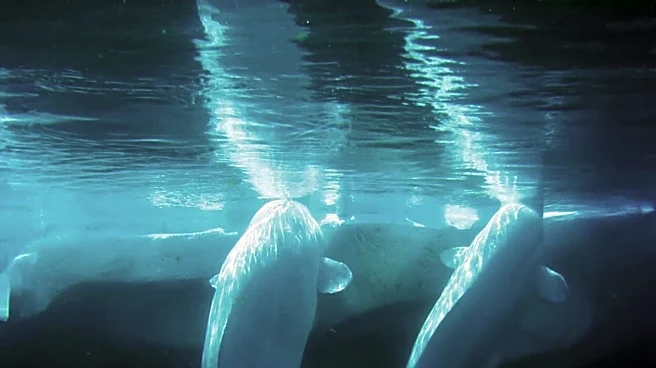
Federal fisheries researchers are investigating the deaths of two beluga whales found in Cook Inlet near Anchorage this week. One adult female beluga was recovered near the mouth of Ship Creek and the Port of Anchorage, where biologists and pathologists
from the National Oceanic and Atmospheric Administration (NOAA) and Alaska Veterinary Pathology Services conducted a necropsy. The second beluga was initially found beached near Birchwood but later drifted back into the water. Officials received reports of both whales on Monday. Verena Gill, a supervisory biologist for NOAA, stated that while finding two deceased belugas in a short period isn't necessarily alarming due to their concentration in river mouths for feeding this time of year, the investigation aims to determine the cause of death, including checking for signs of physical trauma like ship strikes. Cook Inlet belugas are federally endangered, with a population estimated at under 300 in 2019.
Why It's Important?
The deaths of two beluga whales in Cook Inlet are significant due to the critically endangered status of the Cook Inlet beluga population, which is geographically distinct from other Alaskan beluga groups. With fewer than 300 individuals remaining, every loss is a substantial blow to the species' survival and recovery efforts. The investigation into their deaths is crucial for understanding potential threats to this vulnerable population, which could include environmental factors, human activities such as shipping or pollution, or disease. The findings from the necropsies could inform conservation strategies, regulatory actions, and public awareness campaigns aimed at protecting these marine mammals. This event underscores the delicate balance of marine ecosystems and the ongoing challenges in conserving endangered species in areas with human activity.
What's Next?
Researchers will continue to analyze samples from the recovered beluga whale, with necropsy results expected to take several months. These results will be vital in determining the cause of death and identifying any patterns or recurring threats to the Cook Inlet beluga population. Efforts will also be made to recover the second beluga carcass for examination, if possible. NOAA and other conservation groups will likely use these findings to refine and strengthen existing protection measures for the endangered belugas. Public awareness campaigns may also be initiated or intensified to educate residents and marine vessel operators about ways to minimize their impact on beluga whales in Cook Inlet.
Beyond the Headlines
The deaths of these beluga whales highlight the broader ecological pressures faced by marine life in increasingly urbanized coastal environments. Cook Inlet, a vital habitat for belugas, is also a hub for shipping, industrial activity, and human recreation. This situation brings to the forefront the complex challenge of balancing economic development and human needs with the imperative of protecting endangered species. It raises questions about the cumulative impacts of various human activities on marine ecosystems and the effectiveness of current conservation policies. The long-term survival of the Cook Inlet beluga population serves as a barometer for the overall health of the region's marine environment, prompting deeper reflection on human stewardship of natural resources.