





What's Happening?
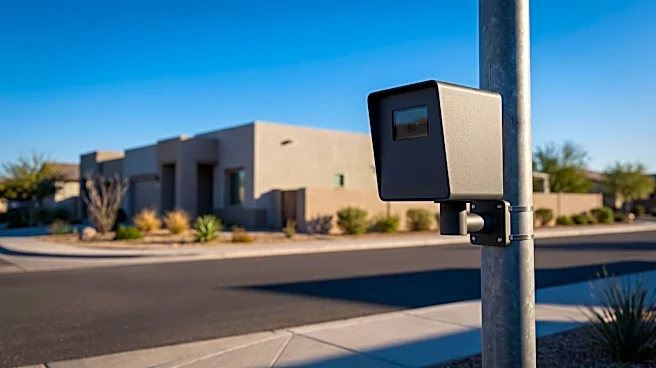
Residents of Rio Rancho, New Mexico, voiced strong opposition to the city's use of Flock license plate cameras at a recent governing body meeting. Concerns primarily revolve around alleged Fourth Amendment violations and the accuracy of the technology.
Speakers, including members of the advocacy group De Flock New Mexico, highlighted the cameras' 93% accuracy rate, arguing that the 7% error margin could lead to a significant number of misreads and potential lawsuits. One resident, Ronald Birkeland, stated that the technology violates the Fourth Amendment rights of citizens. Another resident, Michael Farrell, challenged Mayor Paul Wymer's previous assertion of a 'silent majority' supporting the technology, asking for evidence of this support. City Manager Matt Geisel addressed the public concerns by referring to a detailed presentation on the city's website regarding the license plate reader programs.
Why It's Important?
The ongoing debate in Rio Rancho regarding Flock license plate cameras underscores a broader national discussion about privacy rights versus public safety in the age of advanced surveillance technology. The Fourth Amendment, which protects against unreasonable searches and seizures, is a cornerstone of individual liberties in the U.S. The deployment of automated license plate readers (ALPRs) by law enforcement agencies across the country raises critical questions about data collection, storage, and potential misuse. The accuracy of these systems, as highlighted by the Rio Rancho residents, is also a significant concern, as errors could lead to wrongful stops, investigations, and legal challenges, impacting citizens' trust in local government and law enforcement. This situation reflects a growing tension between technological advancements aimed at crime prevention and the constitutional rights of individuals.
What's Next?
The city of Rio Rancho is likely to continue facing public scrutiny and demands for transparency regarding its Flock license plate camera program. Residents and advocacy groups like De Flock New Mexico are expected to maintain their pressure on the governing body to reconsider or modify the use of this technology. The city may need to provide further detailed explanations and justifications for the program, potentially leading to public forums, additional presentations, or even policy reviews. The ongoing public discourse could also influence other municipalities considering or currently using similar surveillance technologies, prompting them to evaluate the balance between public safety and civil liberties more carefully. Legal challenges based on Fourth Amendment concerns could also emerge if residents feel their rights are being systematically violated.
Beyond the Headlines
The controversy surrounding Flock cameras in Rio Rancho touches upon fundamental ethical and legal dilemmas inherent in modern surveillance. The concept of a 'silent majority' supporting such technology, as mentioned by Mayor Wymer, highlights the challenge of gauging public opinion on complex issues that balance security with privacy. The potential for 'data-sharing failures' and 'financial liability' due to inaccuracies, as raised by Joaquin Montoya, points to the broader implications of relying on AI-driven systems in critical public services. This situation could contribute to a national precedent regarding the regulation and oversight of ALPR technology, potentially influencing future legislation or judicial interpretations of privacy in the digital age. It also raises questions about the role of local governments in adopting technologies that have significant constitutional implications without robust public consent and oversight.