



What's Happening?
On August 30, 1992, astronomers made a significant discovery by spotting the first Kuiper Belt object (KBO) beyond Pluto, officially designated 1992 QB1. This 100-mile-wide object, thousands of times fainter than Pluto, was detected using new digital
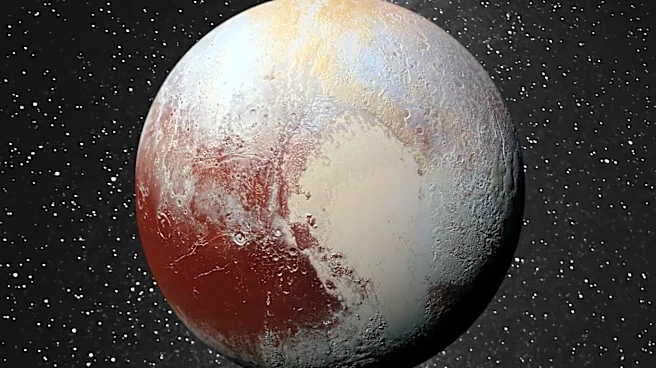
imaging techniques, marking a pivotal moment in solar system exploration. Before this discovery, Pluto was considered the most distant planetary body, and the region beyond Neptune was largely unknown due to the faintness of objects there. The Kuiper Belt, a doughnut-shaped region theorized by Dutch astronomer Gerard Kuiper, begins about 30 AU from the sun and extends to 1,000 AU, making it one of the largest structures in the solar system. The identification of 1992 QB1 confirmed the existence of this vast region and opened the door to discovering over 2,000 more KBOs.
Why It's Important?
The discovery of 1992 QB1 fundamentally reshaped humanity's understanding of the solar system. Prior to this, the solar system was perceived as ending with Pluto, but the confirmation of the Kuiper Belt revealed a much larger and more complex cosmic neighborhood. This finding was crucial in initiating discussions about Pluto's planetary status, especially after larger KBOs like Eris were subsequently found, ultimately leading to Pluto's reclassification as a dwarf planet in 2006. The Kuiper Belt is a relic of the early solar system, and studying its objects provides invaluable insights into planetary formation and evolution. It also highlights the continuous advancement of astronomical technology, as digital imaging techniques enabled the detection of previously unseen, faint objects, pushing the boundaries of observational astronomy.
What's Next?
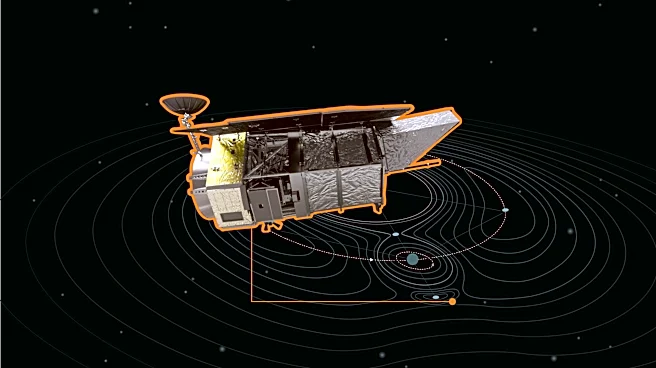
Following the initial discovery, the exploration of the Kuiper Belt has continued to advance. NASA's New Horizons spacecraft, which famously flew by Pluto in 2015, went on to explore another KBO, Arrokoth, in 2019, providing the first close-up images and data from such a distant object. Future missions are likely to continue this exploration, aiming to study more KBOs to understand their diverse compositions, origins, and the conditions of the early solar system. The ongoing cataloging and characterization of KBOs will further refine our models of solar system dynamics and potentially uncover more dwarf planets or other significant celestial bodies. The scientific community will continue to leverage advanced telescopes and imaging technologies to probe this distant region, seeking to unlock more secrets of our cosmic origins.
Beyond the Headlines
The discovery of 1992 QB1 and the subsequent understanding of the Kuiper Belt have profound implications beyond scientific classification. It underscores the dynamic nature of scientific knowledge, where established paradigms can be overturned by new observations and technological advancements. The reclassification of Pluto, a beloved 'planet' for generations, sparked public debate and highlighted how scientific definitions evolve with new evidence. This event also inspires a sense of wonder and curiosity about the unexplored regions of space, reminding us that our solar system is far from fully understood. The Kuiper Belt represents a vast frontier, a 'third zone' of the solar system, offering a glimpse into the raw materials from which planets formed and potentially harboring clues about the origins of life itself.