
What's Happening?
Physicists have successfully simulated a phenomenon known as false vacuum decay, a quantum process theorized to potentially end the universe. This simulation, conducted by researchers studying quantum field behavior, represents the first experimental
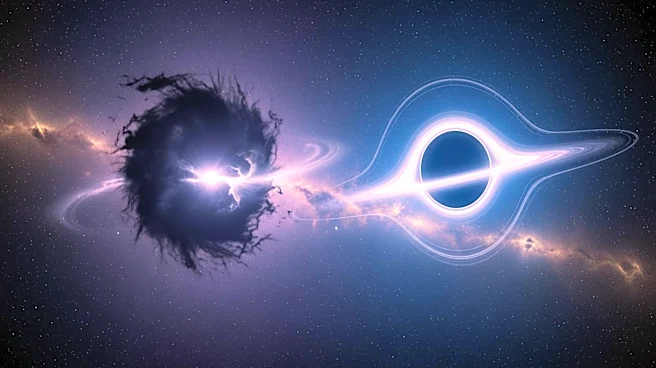
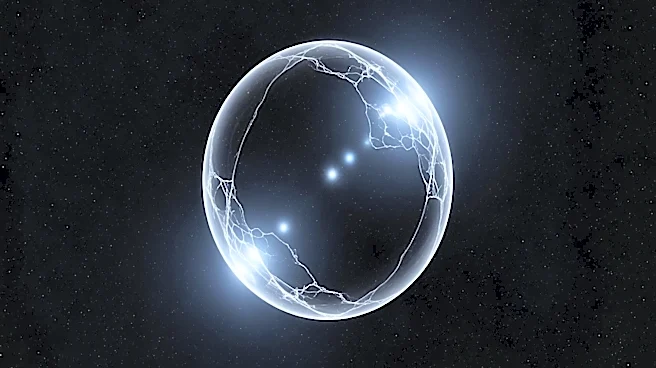
analog of a concept that has largely existed in theoretical cosmology. False vacuum decay involves a scenario where the universe exists in a metastable 'false' vacuum, which could transition to a 'true' vacuum through a quantum tunneling event. This transition would create a bubble of lower-energy vacuum that expands at the speed of light, altering the fundamental constants of physics. Researchers used an analog system, such as an ultracold atomic gas or a coupled quantum circuit, to simulate this process, providing empirical grounding for models that were previously abstract.
Why It's Important?
The simulation of false vacuum decay is significant because it allows researchers to test the mathematical predictions of quantum field theory against real physical behavior. This is crucial for understanding the stability of the universe's vacuum state, which has implications for the Standard Model of particle physics. The measured mass of the Higgs boson suggests that the electroweak vacuum might be metastable, raising questions about cosmic risk. Although the probability of spontaneous false vacuum decay is considered extremely low on human timescales, the simulation helps refine theoretical models and constraints derived from collider data. This research contributes to the broader field of precision quantum engineering, which is essential for advancing fundamental physics experiments.
What's Next?
Researchers aim to develop analog systems with greater fidelity, such as larger qubit arrays and more tunable interaction geometries, to probe bubble nucleation rates and expansion dynamics with higher precision. These advancements could help match experimental results with theoretical predictions, tightening constraints on vacuum stability parameters. The unresolved question of whether the electroweak vacuum is stable or metastable remains a key focus, potentially requiring measurements of the Higgs self-coupling at energy scales beyond the current capabilities of the Large Hadron Collider.