
What's Happening?
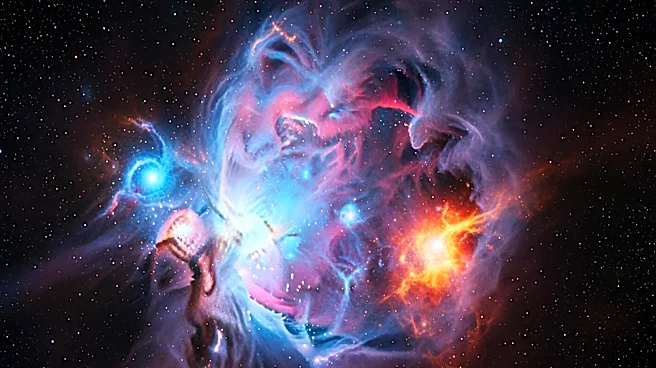
The James Webb Space Telescope has captured stunning images of a nebula surrounding a dying star, revealing mysterious structures known as buckyballs. These carbon molecules, resembling soccer balls, were
first discovered in space in 2010. The new images show intricate details of the nebula, located 10,000 light-years away, and provide insights into the formation and evolution of these carbon structures. The observations highlight the nebula's complex dynamics and the role of buckyballs in cosmic chemistry, offering a deeper understanding of the processes occurring in dying stars.
Why It's Important?
The discovery of buckyballs in the nebula surrounding a dying star provides valuable insights into the chemistry of the universe and the formation of organic molecules. These carbon structures are significant as they are considered building blocks of life, and their presence in space suggests that complex organic chemistry is more widespread than previously thought. The James Webb Space Telescope's ability to capture such detailed images enhances our understanding of the life cycle of stars and the chemical processes that occur in space. This knowledge could have implications for the study of astrobiology and the search for life beyond Earth.
What's Next?
Further analysis of the data collected by the James Webb Space Telescope will focus on understanding the formation and distribution of buckyballs in space. Scientists will continue to study the nebula and other similar regions to gain insights into the processes that lead to the formation of these carbon structures. The findings could influence future research in astrophysics and astrobiology, potentially leading to new discoveries about the origins of life and the chemical evolution of the universe.