
What's Happening?
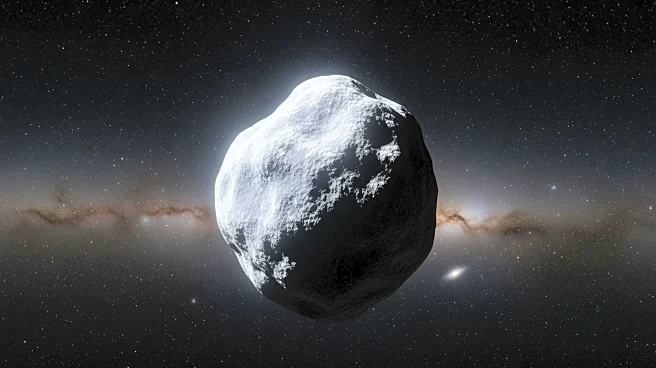
NASA is currently tracking a bus-sized asteroid, designated as '2025 XF1', which is approaching Earth at a speed of nearly 8,000 miles per hour. According to NASA's Center for Near Earth Object Studies
(CNEOS), the asteroid is expected to pass within 195,000 miles of Earth on Saturday. In addition to 2025 XF1, NASA is also observing another bus-sized asteroid, '2025 XK1', which will come within 624,000 miles of Earth on Friday. Furthermore, two plane-sized asteroids, '2020 WH20' and '2016 YH', are also being monitored as they approach Earth at speeds of nearly 20,000 miles per hour, with their closest approaches scheduled for Friday and Saturday, respectively.
Why It's Important?
The monitoring of near-Earth objects (NEOs) like 2025 XF1 is crucial for planetary defense and understanding potential threats from space. While the current asteroids pose no immediate risk of impact, NASA's tracking efforts are part of a broader initiative to identify and study objects that could potentially collide with Earth in the future. This vigilance helps in developing strategies to mitigate any potential threats. The designation of 'potentially hazardous asteroids' (PHAs) is given to those that could pose a risk over long periods, although none are expected to impact Earth soon. NASA's ongoing research and monitoring efforts are vital for ensuring the safety of our planet from cosmic hazards.
What's Next?
NASA will continue to monitor these asteroids as they make their closest approaches to Earth. The agency's efforts are part of a larger mission to track and study NEOs, which involves using telescopes and other technologies to gather data on their trajectories and characteristics. This information is crucial for assessing any future risks and developing potential deflection strategies if necessary. Public interest in space and planetary defense is likely to grow as NASA and other space agencies continue to share their findings and advancements in this field.