






What's Happening?
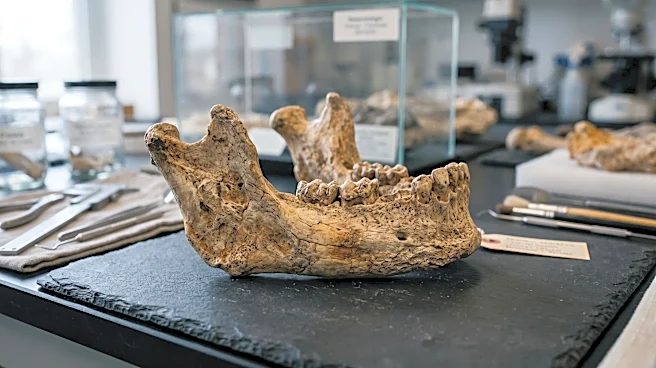
Researchers have reconstructed the facial features of Denisovans, an ancient human species, based on a newly discovered mandible found in China. This discovery, described as "nothing short of sensational," has allowed scientists to create 3D computer
models of the skull and jaw. These models indicate that Denisovans possessed distinct facial characteristics, including low and broad skulls, large, jutting brow ridges, and broad cheekbones. Unlike some other ancient human relatives, their jaw and face were somewhat flattened, protruding only slightly. The identification of these fossils as Denisovan was strongly supported by the presence of a specific collagen protein variation, COL1A2-996K, which is unique to Denisovans and not found in Neanderthals or modern humans. This reconstruction provides crucial insights into the physical appearance of a species about which little was previously known due to the scarcity of fossil evidence. The findings also highlight the genetic connections between Denisovans and other ancient human species, suggesting a more widespread presence across Asia than previously understood.
Why It's Important?
This discovery is important for understanding the complex tapestry of human evolution, particularly the diversity and geographical spread of ancient hominins. By revealing the facial features of Denisovans, scientists can better visualize and categorize this enigmatic group, which lived across Asia between 300,000 and 40,000 years ago. The genetic links identified through the collagen protein variation not only confirm the Denisovan affiliation of the fossils but also provide a molecular marker for future identifications. This helps to fill significant gaps in the fossil record, which has historically been sparse for Denisovans compared to Neanderthals. The finding that Denisovans were more widespread across Asia, with remains found in China beyond the previously known Siberian caves and Tibetan mountains, reshapes our understanding of their migratory patterns and interactions with other ancient human populations. This expanded geographical understanding is crucial for tracing the genetic contributions of Denisovans to modern human populations, particularly in Asia, where their DNA is still found in many genomes.
What's Next?
The identification of these Denisovan fossils and the reconstruction of their facial features will likely spur further archaeological and genetic research across Asia. Scientists will continue to search for more Denisovan remains, particularly in regions where their DNA has been found in modern human populations, to further refine their understanding of the species' geographical range and physical variations. The unique collagen protein marker, COL1A2-996K, will be a valuable tool for identifying other potential Denisovan fossils, even fragmented ones. Future studies may also focus on comparing these newly reconstructed features with other ancient hominins to better understand the evolutionary relationships and divergences within the human family tree. Additionally, the expanded knowledge of Denisovan morphology could lead to more accurate artistic renditions and educational materials, enhancing public understanding of human prehistory.
Beyond the Headlines
Beyond the immediate scientific implications, this discovery deepens our appreciation for the rich and complex history of human evolution. The ability to reconstruct the face of a Denisovan from fragmented remains underscores the power of interdisciplinary research, combining paleontology, genetics, and advanced imaging techniques. It challenges the simplistic view of a linear human evolutionary path, instead presenting a more intricate web of coexisting and interbreeding hominin species. The genetic legacy of Denisovans in modern human populations, particularly in Asia, suggests a history of interspecies interaction and genetic exchange that contributed to the resilience and adaptability of our ancestors. This ongoing revelation of ancient human diversity encourages a broader perspective on what it means to be human, highlighting the shared ancestry and deep connections that bind all people, regardless of modern geographical or cultural distinctions.