








What's Happening?
U.S. Senator Jerry Moran, a Republican from Kansas, has announced that federal funding totaling $405,000 will be allocated to law enforcement agencies in Victoria and Ellis County, Kansas. The Victoria Police Department is set to receive $78,000, while
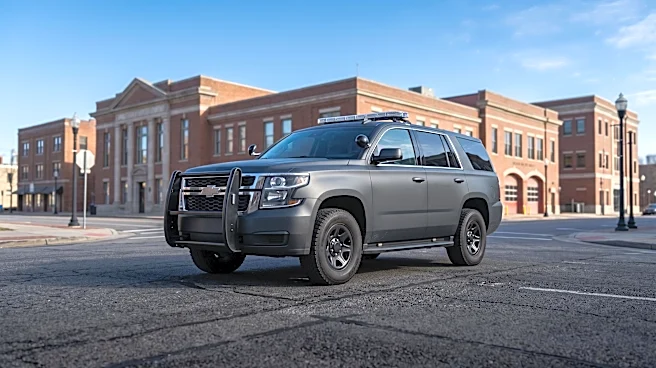
the Ellis County Sheriff's Office will get $327,000. This funding, part of the U.S. Department of Justice’s COPS Office Technology and Equipment Program, aims to help local agencies acquire essential equipment, technology, and training that might otherwise be difficult to afford with local budgets. Senator Moran, who chairs the Senate Appropriations Subcommittee on Commerce, Justice and Science, played a key role in securing these funds, emphasizing that such federal support is crucial for addressing increasing demands on law enforcement, including issues like drug trafficking and human trafficking in rural areas. The Victoria Police Department plans to use its grant for a four-wheel-drive patrol pickup, equipment upgrades, and training, including mass shooting response. The Ellis County Sheriff's Office will replace aging in-car and body-worn cameras with its allocation.
Why It's Important?
This federal funding is critical for enhancing public safety and supporting law enforcement in rural Kansas communities. Senator Moran highlighted that many local governments struggle to keep pace with the rising costs of technology and equipment necessary for modern policing. The grants will enable departments like Victoria Police and Ellis County Sheriff's Office to acquire basic yet vital tools, such as new patrol vehicles, updated camera systems, and specialized training. This directly impacts the effectiveness of law enforcement in responding to evolving challenges, including the spread of drug and human trafficking into rural areas. Furthermore, the investment in body and in-car cameras for the Ellis County Sheriff's Office is expected to reduce complaints, enhance officer safety, and provide crucial evidence for court proceedings, ultimately saving taxpayer dollars in the long run by streamlining operations and improving accountability. The initiative underscores a broader federal commitment to bolstering local law enforcement capabilities across the nation, particularly in areas with limited local resources.
What's Next?
The Victoria Police Department and the Ellis County Sheriff's Office will proceed with implementing their respective plans using the newly secured federal funds. Victoria Police Chief Cole Dinkel indicated that the grant would allow the department to purchase items it would not normally be able to afford, including a new patrol vehicle and upgrades to its camera and radar systems. The department also plans to conduct training on mass shooting responses for both officers and community members. The Ellis County Sheriff's Office will replace 17 in-car cameras and 25 body-worn cameras, transitioning to a unified recording platform. Senator Moran expressed his intention to continue securing federal funding for law enforcement, aiming to extend benefits to all 105 counties in Kansas in 2026, building on the $49.5 million directed to Kansas police departments and sheriff's offices over the past four years. This ongoing effort suggests a sustained focus on federal support for local law enforcement needs.
Beyond the Headlines
The allocation of federal funds to local law enforcement, as facilitated by Senator Moran, highlights a significant trend in how rural communities address public safety challenges. It underscores the increasing reliance of smaller jurisdictions on federal assistance to meet basic operational needs and adapt to contemporary threats. This approach raises questions about the long-term sustainability of local law enforcement funding and the potential for federal influence on local policing priorities. While providing essential resources, it also centralizes decision-making regarding equipment and training standards. The emphasis on technology, such as body cameras, reflects a national push for transparency and accountability in policing, but also introduces considerations about data storage, privacy, and the integration of complex systems into smaller departments. The initiative also implicitly acknowledges that crime and public safety issues, once perceived as urban problems, are now prevalent in rural America, necessitating a more robust and technologically equipped law enforcement presence.