







What's Happening?
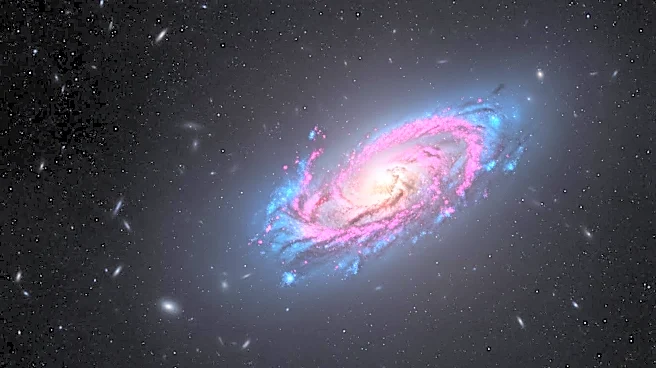
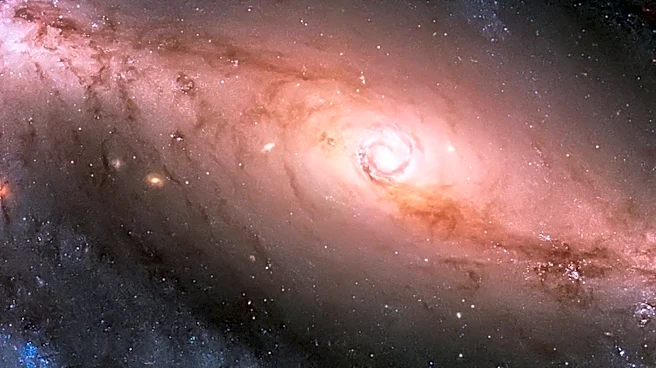
An international team of astronomers, led by Stefanie Komossa from the Max Planck Institute for Radio Astronomy, has observed a unique long-lived radio outburst from the galaxy SDSS J110546.07+145202.4, located about 1.8 billion light-years away in the constellation
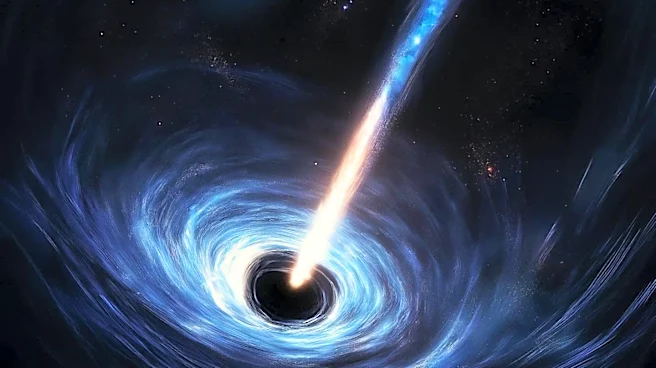
Leo. This galaxy has been emitting intense radio waves for over eight years, a phenomenon not previously observed. The radio emission, which is about 10 quadrillion times as intense as the sun, is believed to originate from a black hole at the galaxy's center. This black hole, although of relatively low mass, is rapidly growing by accreting matter, which has triggered a jet—a concentrated beam of particles traveling at nearly the speed of light.
Why It's Important?
This discovery provides a rare opportunity to study the physical processes associated with black holes and the formation of jets in conditions similar to those of the early universe. The galaxy's proximity allows for detailed observations that can enhance understanding of black hole evolution and jet dynamics. Such high-energy events are crucial for astronomers to gain insights into the extreme environments of the universe. The findings could also help fill gaps in knowledge about the early universe, offering a local laboratory for studying phenomena that are otherwise only observable in distant galaxies.
What's Next?
Future observations with high-resolution instruments like the Very Long Baseline Array (VLBA) are planned to map the structure of the jet and monitor the evolution of the radio emission. Additionally, upcoming facilities like the SKA telescopes will enable the identification of similar radio transients in future sky surveys, further contributing to the understanding of the early universe.