




What's Happening?
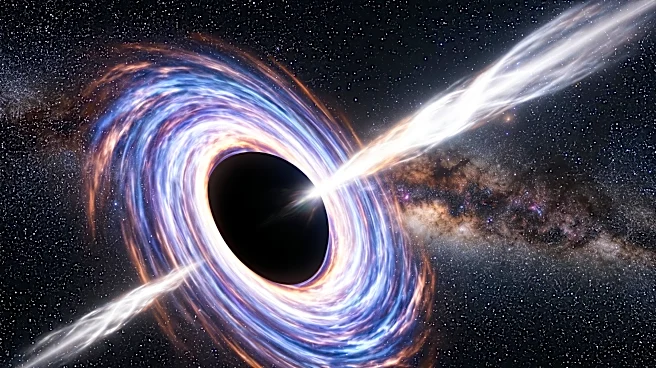
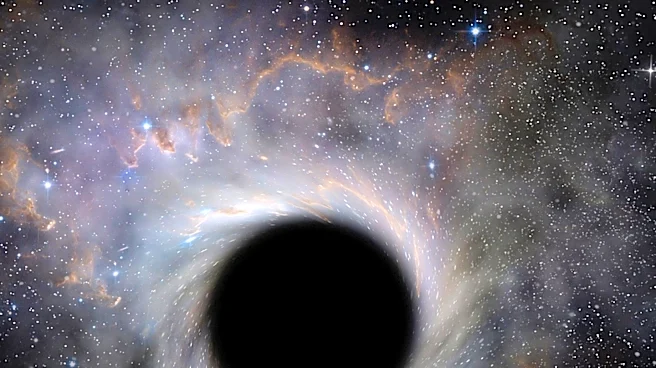
New theoretical research suggests that primordial black holes, hypothetical objects formed in the early universe, might exist in a five-dimensional space rather than the standard four dimensions (three spatial and one temporal). While primordial black holes have
not yet been observed, this study, led by Luis Anchordoqui of Lehman College in the United States, explores their potential existence within the 'dark dimension scenario.' This scenario posits the existence of a hidden extra spatial dimension, approximately one micron wide, where gravity can extend, unlike ordinary matter and forces which are confined to our familiar four dimensions. The research applies proposed rules of quantum gravity to determine how these black holes would behave in such a setting, examining whether they would function as four-dimensional or five-dimensional structures. The findings indicate that some primordial black holes could initially behave as four-dimensional objects before becoming unstable and transforming into five-dimensional ones, while others, formed from cosmic strings, would be five-dimensional from their inception.
Why It's Important?
This theoretical study is important because it attempts to reconcile two major mysteries in cosmology: the existence of primordial black holes and the concept of extra dimensions. If primordial black holes exist and are indeed five-dimensional, it could provide crucial insights into the high-energy physics of the early universe and the nature of dark matter, which these objects might comprise. The 'dark dimension scenario' offers a potential framework for understanding phenomena that are not explained by the standard model of particle physics and general relativity. Confirming the existence of such a dimension and its influence on black hole formation and survival would revolutionize our understanding of spacetime and gravity, potentially leading to a unified theory of physics. It also highlights the ongoing effort to explore alternative cosmological models to explain observed cosmic phenomena.
What's Next?
While this research is purely theoretical, the next steps would involve seeking observational evidence to support the existence of primordial black holes and, more specifically, the 'dark dimension scenario.' This could involve searching for unique gravitational wave signatures that might be produced by five-dimensional black holes or looking for other astrophysical phenomena that could be explained by the presence of an extra dimension. Further theoretical work will also be necessary to refine the models of black hole formation and evolution within a five-dimensional context, potentially leading to more specific predictions that could be tested. The study's authors note that if even one of these theoretical possibilities proves true, it could significantly advance our understanding of the early universe and fundamental physics.
Beyond the Headlines
The concept of extra dimensions, while seemingly science fiction, is a serious area of theoretical physics, particularly in string theory and other quantum gravity models. The 'dark dimension scenario' offers a compelling way to bridge the gap between theoretical constructs and observable phenomena, such as dark matter. This research pushes the boundaries of our understanding of spacetime itself, suggesting that our universe might be more complex and multi-layered than we perceive. The idea that black holes, already enigmatic objects, could exist in a higher dimension adds another layer of complexity and intrigue. It challenges our intuitive understanding of reality and opens up philosophical questions about the true nature of the cosmos and our place within it, potentially leading to a paradigm shift in how we view the fundamental laws of physics.