
What's Happening?
The retired ocean liner SS United States was deliberately sunk on Wednesday, November 11, 2026, off the coast of Florida to create the world's largest artificial reef. The vessel, which is nearly 1,000
feet long and longer than the Titanic, took hours to descend and now rests upright 180 feet beneath the surface of the Gulf of Mexico. This transformation was overseen by Coleen Marine, a marine engineering contracting company specializing in artificial reefs, after Okaloosa County, Florida, acquired the ship in 2024. The SS United States Conservancy, which previously sought to convert the ship into a hotel or museum, sold it due to legal and financial challenges. Susan Gibbs, chair of the Conservancy and granddaughter of the ship's designer William Francis Gibbs, expressed mixed emotions about the sinking, acknowledging both grief and hope for the ship's new purpose. The ship, which set transatlantic speed records on its maiden voyage in 1952 and carried notable passengers like Harry Truman and Walt Disney, will now serve as a deep-sea habitat for marine life and a destination for divers.
Why It's Important?
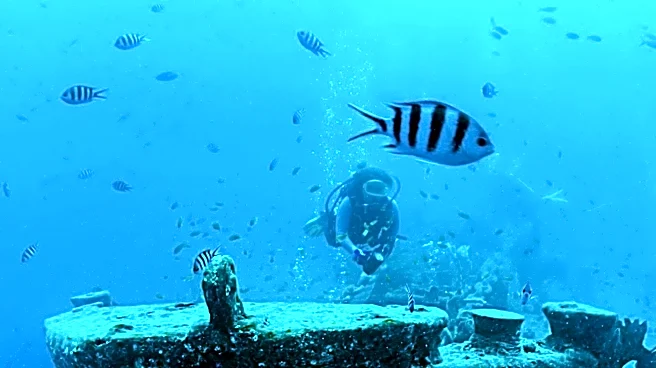
The sinking of the SS United States marks a significant event in marine conservation and historical preservation. By becoming the world's largest artificial reef, the ship will provide a new ecosystem for marine life, enhancing biodiversity and supporting the health of the Gulf of Mexico's aquatic environment. This initiative also creates a unique attraction for divers, potentially boosting tourism and local economies in coastal Florida. The project highlights a creative solution for repurposing large, decommissioned vessels, offering an alternative to traditional scrapping. While the SS United States Conservancy initially aimed for a different fate, the artificial reef project ensures the ship's legacy continues in a new, environmentally beneficial role. This decision reflects a growing trend in utilizing retired infrastructure for ecological purposes, demonstrating how human-made objects can contribute to natural habitats.
What's Next?
Following its deliberate sinking, the SS United States will begin its new life as an artificial reef, attracting marine species and divers. Coleen Marine's efforts to preserve the ship's original design underwater mean that its hundreds of rooms and corridors will become a complex habitat. The SS United States Conservancy plans to construct a museum in Florida in the ship's honor, ensuring its historical significance is not forgotten. This museum will likely serve as an educational center, detailing the ship's past as a record-breaking ocean liner and its current role as an ecological asset. Future monitoring of the reef will be crucial to assess its environmental impact and the success of the habitat creation. The project may also inspire similar initiatives for other large vessels, contributing to a broader strategy for marine conservation and sustainable tourism.
Beyond the Headlines
The transformation of the SS United States from a symbol of American engineering prowess to an artificial reef carries profound symbolic weight. It represents a shift in how society views and repurposes its historical artifacts, moving beyond static preservation to dynamic ecological integration. This act underscores the interconnectedness of human history and natural environments, suggesting that even the grandest human creations can find new purpose in supporting nature. The mixed emotions expressed by Susan Gibbs, balancing grief for the ship's original form with hope for its new role, encapsulate the complex relationship between progress, heritage, and environmental stewardship. This development could also spark broader discussions about the ethical considerations and practical challenges of large-scale marine repurposing projects, setting a precedent for future endeavors.