



What's Happening?
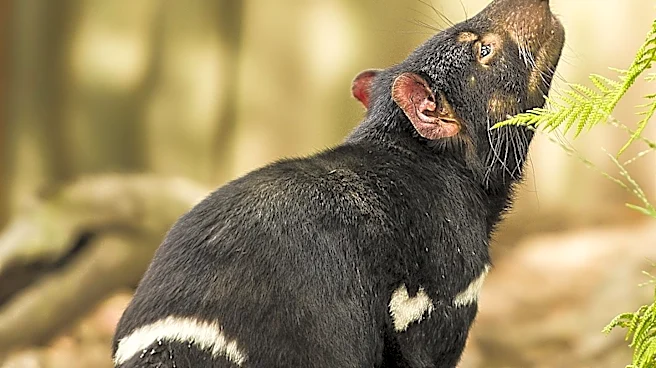
New fossil evidence from the Juukan 2 rockshelter in Western Australia's Pilbara region indicates that Tasmanian devils lived alongside humans approximately 45,000 years ago. This discovery, published in Archaeology in Oceania, includes a lower jaw fragment
dating back 6,900 to 7,300 years and a premolar fragment from 42,500 to 47,100 years ago. Researchers also found over 1,000 animal bones with gnaw marks, with at least 10 exhibiting tooth-pit dimensions consistent with Tasmanian devils. Additionally, 263 digested bone fragments, too large for smaller carnivores, further support the presence of devils. These findings suggest that devils were a consistent part of the scavenger community at Juukan for tens of thousands of years, adapting to significant environmental changes and potentially scavenging at human camps.
Why It's Important?
This research significantly alters our understanding of the historical distribution and ecological role of Tasmanian devils in mainland Australia. Previously, the Pilbara region was a gap in the fossil record for devils. The evidence of their long-term presence and interaction with human populations challenges the notion that devils were restricted to cooler, temperate environments. It also introduces a new hypothesis regarding their mainland extinction around 3,200 years ago. While dingoes have long been implicated due to competition for prey, this study suggests dingoes might have displaced devils from scavenging around human camps, a reliable food source. This highlights a previously underappreciated form of competition that could have contributed to the devils' decline, offering a more nuanced view of ancient ecological dynamics.
What's Next?
Future research will likely focus on further investigating the relationship between dingoes, humans, and Tasmanian devils to solidify the hypothesis of competitive displacement. Scientists will aim to find more direct evidence of dingoes' impact on devil populations and their access to human-provided food sources. This could involve analyzing more archaeological sites for similar patterns of faunal remains and carnivore activity. Additionally, studies might explore the environmental conditions and human behaviors that facilitated this long-term coexistence. The findings could also inform conservation efforts for modern Tasmanian devils by providing insights into their adaptability and historical ecological niches, potentially guiding strategies for reintroduction or habitat management.
Beyond the Headlines
The Juukan 2 rockshelter, already internationally significant due to damage from mining blasting in 2020, continues to yield invaluable insights into Australia's deep past. This discovery underscores the critical importance of preserving such archaeological sites, as they serve as irreplaceable archives of cultural and environmental history. The ethical implications of balancing industrial development with the protection of heritage sites are brought to the forefront. Furthermore, the study highlights the complex and often subtle interactions between different species and humans over millennia, demonstrating how ecological relationships can shift and lead to significant outcomes like extinction. It encourages a broader perspective on conservation, considering not just current threats but also historical ecological pressures and human impacts.


