
What's Happening?
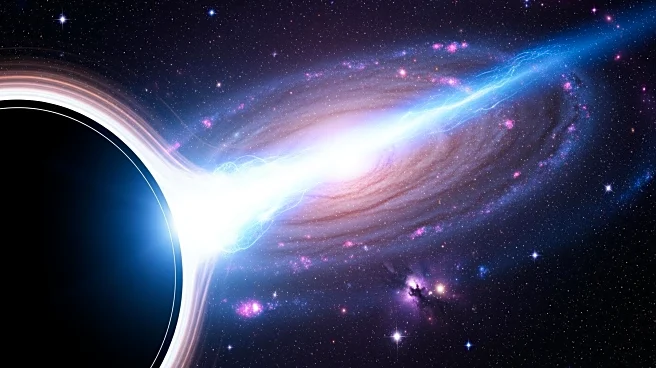
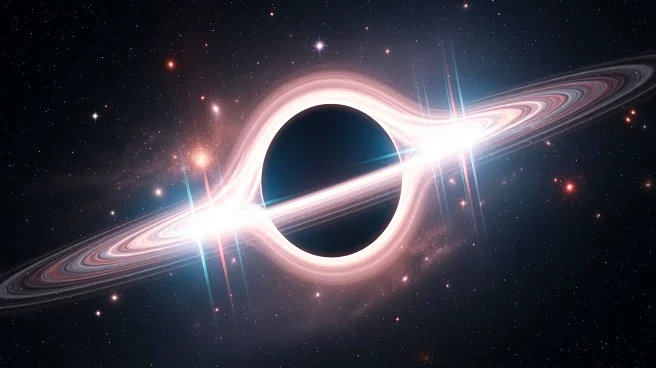
Astronomers at UC Berkeley have identified a black hole as the source of mysterious bright blue flashes in the night sky, known as luminous fast blue optical transients (LFBOTs). These events, which have puzzled
scientists since their discovery, are now believed to be caused by a black hole, up to 100 times the mass of the Sun, tearing apart a massive stellar companion. The most recent and brightest event, cataloged as AT 2024wpp, provided crucial data that ruled out previous theories, such as supernovae. The research suggests that these flashes occur when a black hole in the intermediate-mass regime interacts with a massive star, possibly a Wolf-Rayet star, leading to a dramatic release of energy. This discovery sheds light on the nature of these cosmic phenomena and the environments in which they occur.
Why It's Important?
The identification of black holes as the source of LFBOTs is significant for several reasons. It provides a new understanding of how massive black holes interact with their stellar companions, offering insights into the formation and evolution of such systems. This discovery also has implications for the study of black holes and their role in the universe, particularly in star-forming galaxies. By understanding the mechanisms behind these events, astronomers can better predict and study similar occurrences, enhancing our knowledge of cosmic phenomena. Additionally, this research contributes to the broader field of astrophysics by providing a new perspective on the behavior of black holes and their impact on surrounding matter.
What's Next?
Future research will focus on detecting more LFBOTs to further understand their origins and characteristics. Upcoming ultraviolet observatories, such as ULTRASAT and UVEX, are expected to play a crucial role in identifying these events earlier and more frequently. By capturing LFBOTs before they peak, astronomers hope to map their environments and study the diversity of progenitor systems. This will allow for a more comprehensive understanding of the conditions that lead to such dramatic cosmic events. The continued study of LFBOTs will also provide valuable data for testing theories of black hole formation and behavior.