








What's Happening?
Mary Heilmann, a prominent American artist known for her vibrant and conceptually rich work across painting, sculpture, furniture, and ceramics, has passed away at the age of 86 in Riverhead, New York State. Born in San Francisco, California, on January
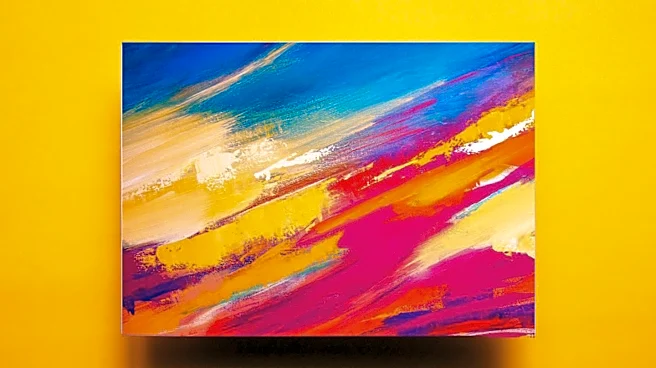
3, 1940, Heilmann's career spanned over five decades, during which she developed a distinctive style that blended formal innovation with a personal and playful sensibility. Her work often incorporated elements of popular culture, Midcentury Modern design, and the influence of digital technology, particularly the colors observed on computer screens. Heilmann's artistic journey began in California, where she earned degrees in English and sculpture, before moving to New York in 1968. She gained significant institutional recognition with a career survey, 'Mary Heilmann | To Be Someone,' which opened in 2007 and traveled to several major U.S. museums, including the New Museum in New York in 2008. Throughout her career, Heilmann was represented by influential galleries such as Paley and Lowe, Holly Solomon, Pat Hearn, and later Hauser & Wirth and 303 Gallery.
Why It's Important?
Mary Heilmann's passing marks the end of an era for a significant figure in American contemporary art. Her unique approach challenged conventional notions of Minimal and Postminimal art by infusing them with vibrant color, emotion, and a sense of freedom. This redefinition has had a lasting impact on how artists and critics perceive the boundaries of abstract art. Heilmann's early experiences with misogyny in the art world, particularly her exclusion from a major Whitney Museum sculpture exhibition in 1969, highlight the historical struggles faced by women artists and underscore her resilience and eventual triumph in establishing her artistic voice. Her embrace of digital technology as an influence on her palette, starting in the mid-1990s, also positions her as a pioneer in exploring the interplay between digital and physical art, a theme that continues to resonate with contemporary artists. Her work is held in major collections and has been exhibited globally, solidifying her legacy as an artist who bridged different artistic movements and cultural influences.
What's Next?
The legacy of Mary Heilmann is expected to continue influencing contemporary art, particularly in discussions surrounding abstraction, color theory, and the integration of digital aesthetics into traditional art forms. Her extensive body of work, which includes paintings, sculptures, and ceramics, will likely be the subject of further academic study and exhibitions. Institutions that hold her work, such as the Whitney Museum of American Art and the Museum of Modern Art, will continue to showcase her contributions. The galleries that represented her, Hauser & Wirth and 303 Gallery, will undoubtedly play a role in preserving and promoting her artistic heritage. Her impact on younger generations of artists, particularly those exploring the intersection of technology and art, will also be a point of continued interest. The art world will likely reflect on her unique ability to combine rigor and geometry with improvisation and gesture, ensuring her place in art history.
Beyond the Headlines
Beyond her artistic achievements, Mary Heilmann's life story offers deeper insights into the evolution of the American art scene and broader societal shifts. Her early exposure to Midcentury Modern architecture and the vibrant countercultures of California, including beat, hippie, and surf cultures, profoundly shaped her artistic perspective. Her personal struggles, including a battle with addiction and subsequent sobriety in 1983, underscore the human element behind artistic creation and the transformative power of personal recovery. Heilmann's ability to navigate and challenge the male-dominated art world of the late 1960s and 1970s, as evidenced by her 'sarcastic' and 'ornery' persona, speaks to the broader feminist movements of the era. Her work, often described as 'songs for the eyes,' transcended mere aesthetics, offering a profound emotional and theoretical engagement with color and form. This blend of personal narrative, cultural commentary, and artistic innovation ensures her enduring relevance.