




What's Happening?
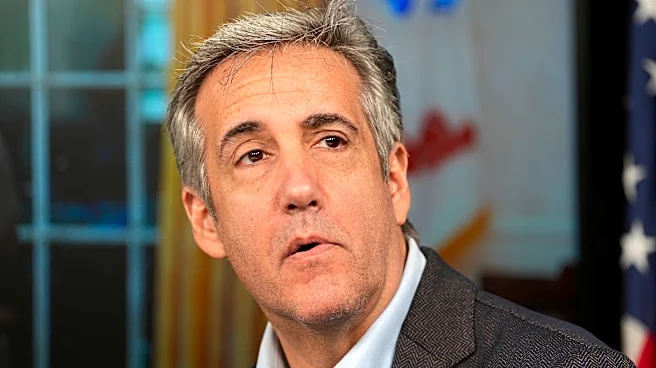
President Trump and his former personal attorney, Michael Cohen, have publicly reconciled during a radio interview, marking their first public conversation in eight years. Cohen, who previously served as a key witness against President Trump in his 2024
criminal trial related to hush-money payments, referred to President Trump as 'boss' during the exchange. President Trump, in turn, praised Cohen for 'recanting everything you said.' This development follows Cohen's recent application for a pardon from President Trump, after an initial request for clemency was denied by Joe Biden. Cohen had publicly stated in January of the previous year that he felt 'pressured and coerced' by federal prosecutors during the hush-money trial. The interview, recorded on Thursday and broadcast on 77WABC, represents a significant shift in their relationship, which had been characterized by Cohen's fierce criticism of President Trump following his own imprisonment for campaign finance violations, tax evasion, bank fraud, and lying to Congress.
Why It's Important?
This reconciliation between President Trump and Michael Cohen carries substantial political and legal implications. Cohen was a pivotal figure in the 2024 criminal trial where President Trump was found guilty on 34 counts of falsifying business records. His testimony was central to the prosecution's case, and his subsequent 'recantation' could potentially be leveraged by President Trump's legal team in future appeals or political narratives. The shift in Cohen's stance, particularly his claim of being 'pressured and coerced' by federal prosecutors, could fuel arguments of political weaponization of the justice system, a narrative frequently advanced by President Trump. For President Trump, securing a pardon for Cohen, or even the public perception of a reconciliation, could be seen as an attempt to consolidate support and undermine past legal challenges. Conversely, critics may view this as a cynical political maneuver, questioning the sincerity of Cohen's change of heart and its potential impact on the integrity of past legal proceedings. The event highlights the complex and often unpredictable dynamics within U.S. political circles, especially concerning figures associated with President Trump.
What's Next?
The full interview between President Trump and Michael Cohen is scheduled to air on Sunday, which will likely provide more details and context regarding their reconciliation. This broadcast is expected to generate significant media attention and public discussion, potentially influencing public opinion regarding President Trump's legal battles and political standing. Following the interview, there will likely be reactions from various stakeholders, including legal experts, political commentators, and the public. Legal analysts will scrutinize Cohen's statements for any potential impact on President Trump's ongoing legal challenges or appeals. Political opponents may criticize the reconciliation as a strategic move to discredit past testimonies. Furthermore, the outcome of Cohen's pardon application from President Trump will be closely watched, as it could set a precedent or signal future actions regarding individuals involved in past legal proceedings against President Trump. The event could also prompt further examination of the role of former associates in high-profile political and legal cases.
Beyond the Headlines
The reconciliation between President Trump and Michael Cohen delves into deeper themes of loyalty, betrayal, and redemption within the high-stakes world of U.S. politics. Cohen's journey from being President Trump's 'fixer' who would 'take a bullet' for him, to becoming a vocal critic who called him a 'conman' and 'racist,' and now back to a seemingly amicable relationship, raises questions about the nature of political alliances and personal integrity. This shift could be interpreted as a pragmatic move by Cohen, seeking a pardon and potentially a return to a more favorable public or legal position. It also highlights the intense pressure and personal cost associated with being involved in politically charged legal battles. The narrative of 'weaponization' of the justice system, which President Trump and now Cohen are echoing, could have long-term implications for public trust in legal institutions and the perception of political fairness. The event underscores how personal relationships, even those marked by profound conflict, can be fluid and subject to dramatic reversals when political or personal interests align, challenging conventional understandings of accountability and justice.