





What's Happening?
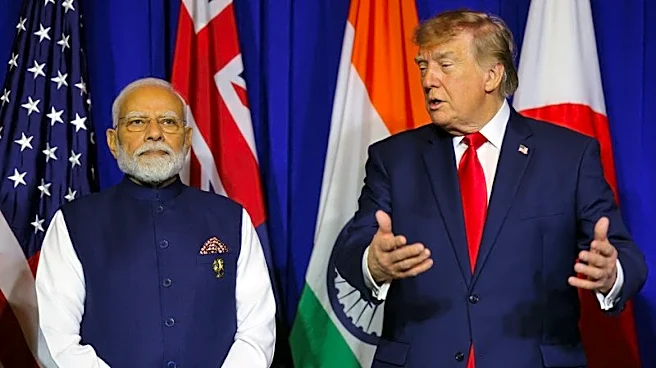
India and the United States are close to finalizing a trade deal, with negotiations largely concluded on most elements. However, the formal signing and rollout of the agreement are currently on hold, pending clarity from the U.S. on its future tariff
architecture. According to Commerce Secretary Rajesh Agrawal, discussions have been built on a U.S. tariff setup that has since been overturned, and India is seeking to understand the outcomes of U.S. Section 301 investigations, the new rates that will apply, and how India's treatment will compare to other U.S. trading partners. The initial phase of the deal, which has been nearly two years in the making, will cover goods only, with matters related to services to be addressed in a subsequent tranche. Officials from both New Delhi and Washington have signaled that the first phase is very close to completion, with a U.S. delegation having recently visited India for discussions.
Why It's Important?
This impending trade deal is significant for both the U.S. and Indian economies, as it has the potential to reshape trade flows, market access, and pricing for a wide range of goods. For U.S. businesses, clarity on tariff rates and India's relative treatment could reset expectations for exporters, supply chain operations, and consumer goods companies involved in India-U.S. trade. A finalized agreement could reduce trade barriers, potentially leading to increased exports for U.S. companies and more competitive pricing for consumers. Conversely, continued uncertainty regarding tariffs could prolong market volatility and complicate strategic planning for businesses operating in or looking to enter these markets. The deal's focus on goods in its initial phase suggests immediate impacts on manufacturing and agricultural sectors, while the future inclusion of services could open up new opportunities for U.S. service providers. The resolution of this trade agreement is crucial for fostering stronger economic ties between the two nations.
What's Next?
The next critical step is for the U.S. to provide definitive clarity on its tariff architecture, including the outcomes of Section 301 investigations and the new rates applicable to India. Until this information is available, the formal signing and implementation of the trade deal will remain pending. Once the tariff picture is clear, India and the U.S. can proceed with finalizing and rolling out the agreement. Following the initial phase covering goods, both countries are expected to move towards negotiations on services, which could further expand the scope of their economic partnership. Businesses and investors will be closely monitoring these developments, as the clarity on tariffs will directly influence their strategic decisions regarding supply chains, market entry, and investment in both countries. The timeline for these clarifications remains uncertain, but both sides are striving to conclude negotiations as soon as possible.
Beyond the Headlines
The delay in signing the India-U.S. trade deal due to tariff uncertainty highlights the complex interplay between domestic trade policy and international agreements. The U.S.'s internal review of its tariff architecture, particularly Section 301 investigations, has broader implications beyond this specific deal, affecting its trade relations with multiple partners. For India, securing favorable and predictable tariff treatment is crucial for its economic growth and its position in global supply chains. This situation also underscores the importance of stable and transparent trade policies for fostering international commerce and investment. The ongoing negotiations reflect a strategic effort by both nations to strengthen their economic partnership amidst evolving geopolitical landscapes. The eventual resolution of this deal could serve as a model for future trade agreements, demonstrating how major economies navigate complex tariff issues to achieve mutually beneficial outcomes.