


What's Happening?
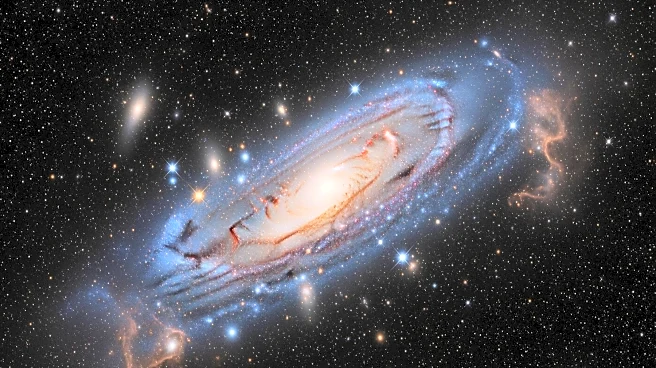
The James Webb Space Telescope (JWST) has been utilized by an international team of astronomers to study the nearby spiral galaxy NGC 628, also known as Messier 74. This galaxy, located approximately 30 million light-years away, is known for its vibrant
star formation and hosts numerous young star clusters (YSCs) within its spiral arms. The study, led by Helena Faustino Vieira from Stockholm University, focuses on the emerging young star clusters (eYSCs) that are still embedded in their natal clouds. These clusters are crucial for understanding star formation and galactic dynamics. The JWST's Near Infrared Spectrograph (NIRSpec) was employed to penetrate the dusty molecular clouds and reveal the emerging clusters, as part of the Feedback in Emerging extrAgalactic Star clusTers (FEAST) program. The observations identified numerous helium and hydrogen recombination lines, as well as molecular hydrogen transitions and polycyclic aromatic hydrocarbons (PAH) emissions, indicating the presence of young, massive stars.
Why It's Important?
The study of emerging young star clusters (eYSCs) in NGC 628 provides significant insights into the early stages of star formation and the evolution of galaxies. Understanding these clusters helps astronomers learn about the processes that govern the formation of stars and the dynamics within galaxies. The findings from the JWST observations suggest that the eYSCs are in an early and energetic evolutionary phase, with hot, young massive stars driving stellar feedback. This research contributes to the broader understanding of how star clusters evolve and interact with their surrounding environments, which is essential for constructing accurate models of galactic evolution. The ability of the JWST to observe these clusters through their dusty environments marks a significant advancement in astronomical research, offering a clearer view of the processes occurring in distant galaxies.
What's Next?
Future research will likely focus on further characterizing the properties of these emerging young star clusters and their impact on the surrounding interstellar medium. Continued observations with the JWST and other telescopes will help refine models of star formation and galactic dynamics. Additionally, the study of similar clusters in other galaxies could provide comparative data to enhance our understanding of universal star formation processes. The ongoing analysis of the data collected by the JWST will also contribute to the development of new theories regarding the lifecycle of star clusters and their role in the evolution of galaxies.
Beyond the Headlines
The observations of eYSCs in NGC 628 highlight the importance of advanced telescopes like the JWST in uncovering previously hidden aspects of the universe. The ability to observe these clusters through their dusty environments opens new avenues for research into the early stages of star formation. This study also underscores the interconnectedness of various astronomical phenomena, as the feedback from young stars influences the surrounding interstellar medium and contributes to the broader galactic ecosystem. The findings may also have implications for understanding the conditions necessary for star formation in different types of galaxies, potentially informing the search for habitable planets in the universe.