



What's Happening?
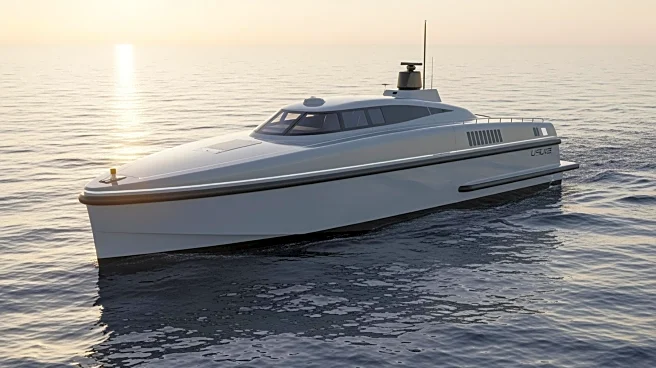
The UK-based company Oshen is advancing its development of unmanned surface vehicles (USVs) in collaboration with the UK Ministry of Defence and the U.S. National Oceanic and Atmospheric Administration (NOAA). The initiative aims to create a network of small,
persistent maritime early warning systems. Oshen's C-Star USVs are designed to operate in large numbers, providing intelligence, surveillance, and reconnaissance (ISR) capabilities across vast oceanic areas. These vehicles are equipped with passive acoustic sensors for anti-submarine warfare and electro-optic/infrared sensors for visual surveillance. A significant milestone was achieved when a C-Star USV successfully captured and transmitted data from inside a category 5 hurricane, Humberto, demonstrating its resilience and capability in extreme conditions.
Why It's Important?
The development of Oshen's USVs represents a significant advancement in maritime surveillance technology, offering a cost-effective and scalable solution for monitoring vast oceanic regions. This technology is particularly relevant given the increasing maritime threats in Euro-Atlantic areas, including those posed by Russia. The ability to deploy a large number of USVs quickly and efficiently could enhance national security and provide critical data for both military and environmental applications. The collaboration with NOAA also highlights the potential for these vehicles to contribute to scientific research and disaster response efforts.
What's Next?
Oshen plans to expand its fleet to 1,000 C-Star USVs, creating extensive maritime picket lines for continuous surveillance. This expansion could lead to increased production rates and further collaboration with international partners. The company's approach to manufacturing, likened to a fast-food model, suggests a focus on rapid, scalable production, which could revolutionize the deployment of maritime surveillance systems. As these systems become operational, they may influence strategic military planning and international maritime policies.