






What's Happening?
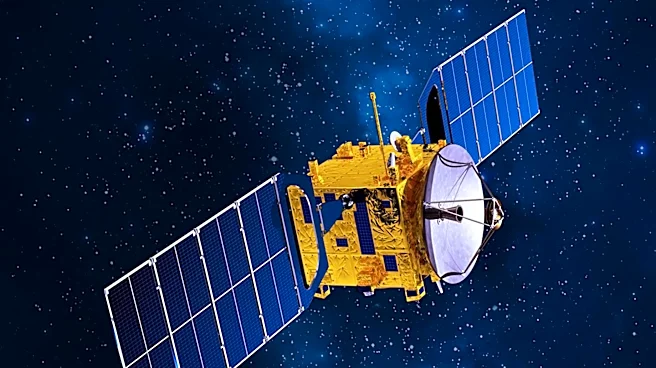
A Russian military satellite, Kosmos 2612, recently approached within a few hundred meters of ICEYE-X36, a radar satellite providing data to Ukraine. This close approach, lasting for the better part of a day, is described as a sophisticated characterization
mission. The U.S. has deemed the operation consistent with an on-orbit weapons operation, citing its 'dangerously close' proximity. Analysts suggest Russia undertook this high-investment mission not merely as a capability demonstration, but to gather precise data on ICEYE's antenna. This data is crucial for developing advanced jammers or spoofers capable of degrading or falsifying the imagery collected by ICEYE satellites, which are vital for Ukraine's intelligence, surveillance, target acquisition, and reconnaissance (ISTAR) infrastructure.
Why It's Important?
This incident signifies a critical escalation in space warfare capabilities and tactics. By conducting a 'Space CTR' (Close-Target Reconnaissance), Russia aims to gain a significant battlefield advantage in Ukraine by disrupting space-based intelligence. A sophisticated jammer, built with precise knowledge of ICEYE's antenna parameters, could operate from Russian-held territory with less power, targeting weaker 'sidelobes' of the radar, making it harder to detect and counter. Furthermore, the collected data could enable Russia to develop spoofers to inject false images, deceiving Ukraine's targeting systems. Given that ICEYE operates a constellation of over 70 near-identical radars, a countermeasure developed against one satellite could potentially affect a large portion of the constellation, severely impacting Ukraine's ability to conduct effective military operations.
What's Next?
Russia is expected to leverage the data collected from this mission to build and field advanced jammers or spoofers within the next 12 months. These countermeasures would aim to degrade or falsify ICEYE's imagery of Ukraine, thereby weakening Ukraine's ISTAR capabilities. The success of such a system could significantly alter the dynamics of the conflict, potentially blinding or providing false intelligence to Ukrainian forces. Beyond Ukraine, there is a high likelihood that Russia will share or leverage these improved technical countermeasures to assist allies like Iran, North Korea, and China against Western synthetic aperture radar (SAR) constellations in future conflicts, indicating a broader strategic shift in space-based electronic warfare.
Beyond the Headlines
This event highlights the increasing weaponization of space and the growing vulnerability of satellite infrastructure. The concept of 'Space CTR' introduces a new dimension to intelligence gathering and electronic warfare, where physical proximity in orbit is used to gain critical technical insights. This raises significant questions about international norms and regulations regarding satellite interactions and potential 'red lines' in space. The development of such precise jamming and spoofing capabilities could lead to a new arms race in space, focusing on counter-space technologies. It also underscores the critical reliance of modern military operations on space-based assets and the imperative for nations to develop robust defenses and countermeasures to protect their own satellite networks while being able to disrupt those of adversaries. The ethical implications of blinding or deceiving an adversary's intelligence systems through such means also warrant deeper consideration.