



What's Happening?
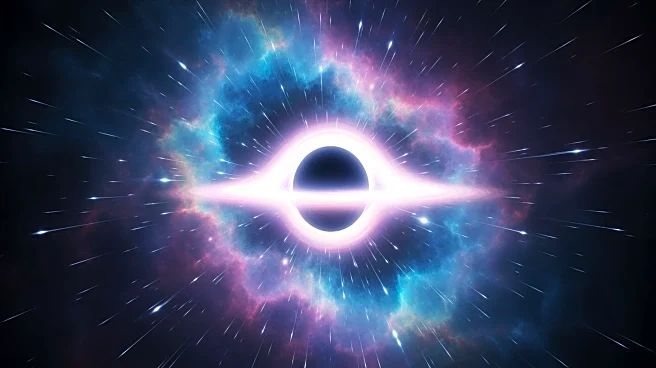
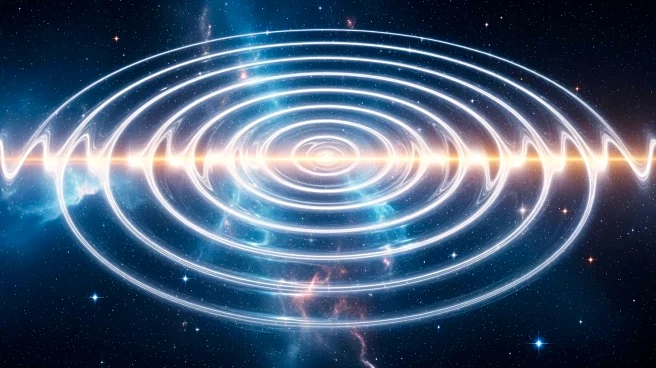
A gravitational wave signal, GW250114, detected by the LIGO-VIRGO-KAGRA collaboration, has provided the clearest evidence yet for testing Einstein's theory of general relativity. This signal, resulting from the collision of two black holes, was recorded
with unprecedented clarity due to advancements in detection technology. The study, involving Cornell physicist Keefe Mitman, confirms that the signal's behavior aligns with predictions made by general relativity. The ability to measure multiple tones from the black hole merger allows for independent verification of the theory, reinforcing its validity.
Why It's Important?
This discovery is significant as it strengthens the foundation of general relativity, a cornerstone of modern physics. The ability to test and confirm Einstein's predictions with such precision opens new avenues for exploring the universe's fundamental laws. It also highlights the potential for future gravitational wave detections to reveal deviations from general relativity, which could lead to breakthroughs in understanding quantum gravity and resolving inconsistencies between general relativity and quantum mechanics.
What's Next?
Researchers anticipate that future gravitational wave signals may not fully align with general relativity, offering insights into unresolved mysteries like dark energy and dark matter. Continued advancements in detection technology and international collaboration will be crucial in capturing more detailed data from black hole mergers. These efforts could eventually lead to a unified theory of gravity that reconciles general relativity with quantum mechanics.