
What's Happening?
The U.S. Southwest, particularly the Four Corners region, experienced back-to-back extreme rain events in late October and early November 2026. These heavy downpours significantly alleviated short-term
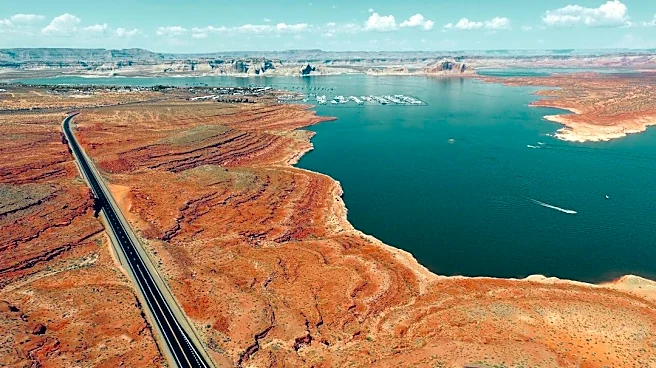
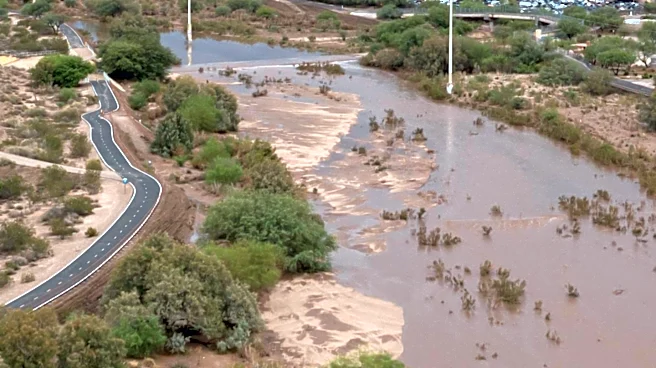
drought conditions that had been exacerbated by a snow drought and high temperatures earlier in the year. One notable impact was the rapid rise of water levels in Navajo Reservoir, located in northern New Mexico and southern Colorado. Between September 20 and November 7, the reservoir's water level increased by nearly 60 feet (18 meters), reaching 108 percent of its average capacity for that date. This contrasts sharply with its 60 percent capacity in September. While the rains provided drought relief, they also caused rivers like the San Juan and Piedra to swell, leading to record or near-record flood levels in some areas, including Pagosa Springs, Colorado, where evacuations and property damage occurred.
Why It's Important?
This event highlights the critical and often volatile nature of water resources in the U.S. Southwest, a region consistently battling long-term drought. The rapid shift from severe drought conditions to significant rainfall and flooding underscores the challenges of water management and climate variability. The replenishment of Navajo Reservoir is vital for regional water supply, supporting agriculture, municipal use, and ecosystems. However, the accompanying flooding demonstrates the dual impact of extreme weather events, where relief from one crisis can trigger another. This situation emphasizes the need for robust infrastructure and adaptive management strategies to cope with both water scarcity and excess. The event also provides valuable data for climate scientists and policymakers, informing future drought monitoring, flood prediction, and water resource planning in a changing climate.
What's Next?
While short-term drought conditions have improved in the Southwest and Great Basin, long-term drought persists in many areas, indicating that sustained water management efforts remain crucial. Experts note that wet weather in the Southwest is often associated with El Niño events, and the current El Niño pattern could increase the likelihood of more moisture-laden storms. This suggests a continued need for vigilance regarding both potential flooding and the long-term sustainability of water supplies. Water managers will likely focus on optimizing reservoir operations to balance flood control with water storage for future dry periods. Communities will also need to assess and repair flood damage, and potentially enhance their flood mitigation infrastructure. Ongoing monitoring of climate patterns and water levels will be essential for informed decision-making in the coming months and years.
Beyond the Headlines
The dramatic fluctuations in water levels in the Southwest reflect broader climate change impacts, where extreme weather events, including both droughts and intense precipitation, are becoming more frequent and severe. This scenario challenges traditional water management paradigms, which often rely on historical averages. The ethical implications extend to equitable water distribution, particularly in regions with competing demands from urban centers, agriculture, and indigenous communities. The economic costs associated with both drought (crop losses, water restrictions) and flooding (infrastructure damage, emergency response) are substantial, underscoring the need for significant investment in resilient water systems. Culturally, water holds immense significance in the Southwest, and these events deeply impact the way communities interact with and plan for their environment, potentially leading to new approaches in resource stewardship and inter-state cooperation.