



What's Happening?
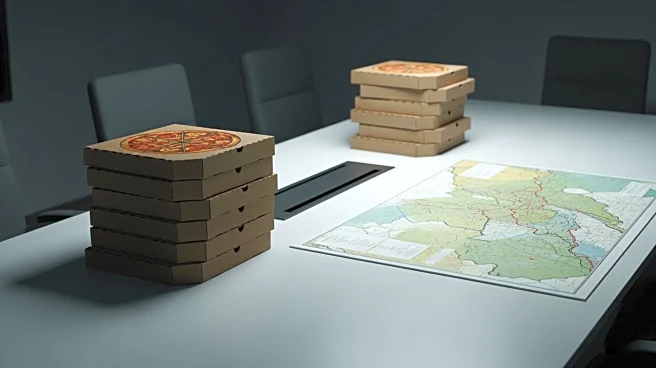
The Pentagon Pizza Index (PPI) is a theory suggesting that spikes in pizza deliveries to U.S. government buildings, particularly the Pentagon and the White House, correlate with imminent military operations. This theory dates back to the 1980s, with notable
instances such as the U.S. invasions of Grenada in 1983 and Panama in 1989. The PPI gained further attention during the Gulf War buildup in 1991. Recent examples include increased pizza orders before the killing of Osama bin Laden and operations involving Venezuelan leader Nicolás Maduro. Observers noted a spike in pizza deliveries in Washington before Israeli airstrikes on Iran in June 2025. Despite its popularity among intelligence analysts and enthusiasts, Pentagon officials dismiss the PPI as unreliable, with some suggesting it could be used for psychological warfare against open-source intelligence trackers.
Why It's Important?
The PPI highlights the intersection of seemingly mundane activities, like pizza deliveries, with significant geopolitical events. It underscores the innovative ways analysts and enthusiasts attempt to predict military actions using open-source intelligence. While the PPI is often dismissed by officials, its persistence reflects a broader interest in unconventional methods of intelligence gathering. This phenomenon also raises questions about the reliability of such indicators and the potential for misinformation. The PPI's popularity suggests a public fascination with the hidden signals of government operations, emphasizing the need for critical evaluation of open-source data in intelligence analysis.
What's Next?
While the PPI remains a topic of interest, its future as a reliable indicator is uncertain. Pentagon officials have expressed skepticism, and there is potential for deliberate misinformation to disrupt the index's accuracy. Analysts may continue to explore alternative indicators, such as the 'Bar Index,' which tracks nightlife activity in Washington to gauge government staff presence. However, these methods carry risks of false positives due to normal fluctuations in activity. The ongoing interest in the PPI and similar indices may drive further innovation in open-source intelligence, but it also necessitates caution in interpreting such data.
Beyond the Headlines
The PPI phenomenon reflects broader cultural and ethical considerations in intelligence gathering. It raises questions about privacy and the ethical implications of using commercial data for intelligence purposes. Additionally, the reliance on such indices highlights the challenges of distinguishing between correlation and causation in data analysis. As technology advances, the potential for more sophisticated open-source intelligence methods grows, prompting discussions about the balance between transparency and security. The PPI serves as a reminder of the complexities involved in interpreting data and the importance of critical thinking in intelligence work.