







What's Happening?
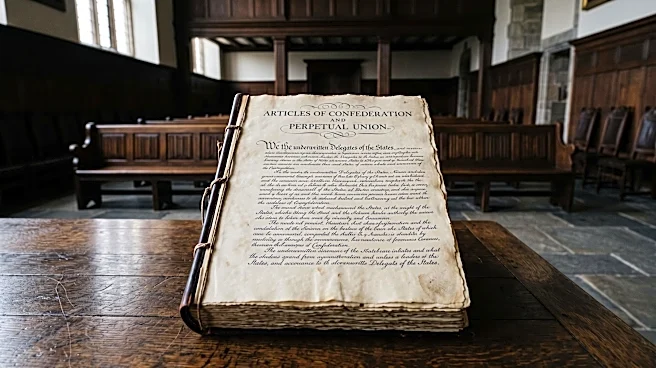
On November 15, 1777, the Continental Congress, meeting in York, Pennsylvania, officially adopted the Articles of Confederation and Perpetual Union. This document served as the first constitution of the United States, establishing a framework for the newly
independent states. Following its adoption, the Articles were dispatched to the individual states for ratification. The ratification process was extensive and was not fully completed until 1781, marking a significant step in the formation of the American government. This historical event laid the groundwork for the nation's initial governing structure, preceding the U.S. Constitution.
Why It's Important?
The adoption of the Articles of Confederation was a pivotal moment in early American history, representing the first attempt to create a unified government among the thirteen colonies after declaring independence. It established a loose confederation of states, where states retained significant autonomy and the central government had limited powers. This structure reflected the colonists' fear of a strong central authority, a sentiment born from their experiences under British rule. While ultimately replaced by the U.S. Constitution due to its weaknesses, the Articles provided valuable lessons in governance and highlighted the challenges of balancing state sovereignty with national unity. Its existence demonstrated the nascent nation's commitment to self-governance and its struggle to define its political identity.
What's Next?
The Articles of Confederation, despite being adopted in 1777, faced a lengthy ratification process, not being fully approved by all states until 1781. This delay underscored the challenges of achieving consensus among the newly independent states. Following its full ratification, the Articles would serve as the governing document for the United States for several years. However, its inherent weaknesses, particularly the lack of a strong central government capable of enforcing laws, collecting taxes, and regulating commerce, would eventually lead to calls for reform. These shortcomings would ultimately pave the way for the Constitutional Convention in 1787 and the drafting of the U.S. Constitution, which would establish a more robust federal system.
Beyond the Headlines
The Articles of Confederation's emphasis on state sovereignty over a strong central government had profound implications for the early American republic. It fostered a sense of independent state identity, which would continue to influence political discourse and regional differences for decades. The challenges faced under the Articles, such as economic instability and interstate disputes, highlighted the critical need for a more unified national identity and a stronger federal framework. This period of governance, though brief, was crucial in shaping the American political philosophy, demonstrating the complexities of creating a republic and the ongoing tension between local autonomy and national cohesion. It served as a foundational experiment in self-governance, informing the subsequent development of American constitutional law and federalism.