






What's Happening?
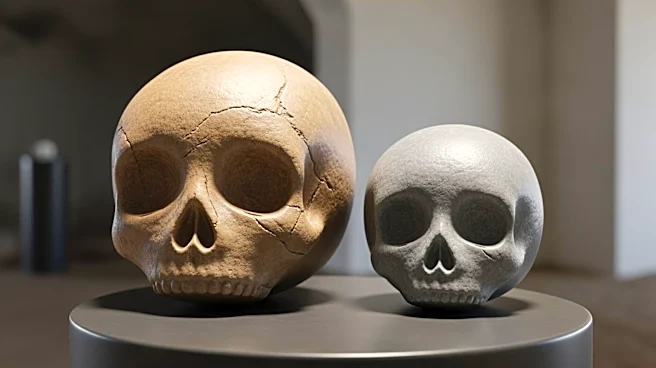
A team of scientists from Israel and Europe has discovered that Neanderthal infants were significantly larger and developed more rapidly than modern human babies. This conclusion was drawn from the analysis of a six-month-old Neanderthal child's remains,
which were found in a cave in Northern Israel. The child's skeletal remains, dating back 51,000 to 56,000 years, revealed thick bones and a large skull, suggesting an older age. However, the development of the teeth indicated a much younger age, as detailed in a study published in the journal Current Biology. The research highlights that Neanderthal infants, much like the fictional character Bamm-Bamm Rubble from 'The Flintstones', were robust and well-built, a trait that likely contributed to their survival in the harsh conditions of prehistoric Europe and Asia.
Why It's Important?
This discovery provides significant insights into the evolutionary biology of Neanderthals, who lived between 400,000 to 40,000 years ago. Understanding the growth patterns of Neanderthal infants helps scientists comprehend how these ancient humans adapted to their environment, which was considerably more challenging than today. The robust nature of Neanderthal children suggests a natural selection process favoring quick maturation and energy expenditure, crucial for survival. This research also underscores the genetic and evolutionary links between Neanderthals and modern humans, as evidence shows interbreeding between the two species, leaving traces in contemporary human DNA.
What's Next?
Further research is likely to continue exploring the genetic and developmental differences between Neanderthals and modern humans. Scientists may focus on uncovering more about the environmental adaptations and survival strategies of Neanderthals, which could provide broader insights into human evolution. Additionally, the study of Neanderthal remains could lead to more discoveries about their social structures, behaviors, and interactions with early modern humans.
Beyond the Headlines
The findings also raise questions about the cultural and social dynamics of Neanderthals, particularly in how they raised their young in challenging environments. The robust nature of Neanderthal infants might have influenced their social structures and survival strategies. Moreover, the evidence of interbreeding with modern humans suggests complex interactions between the two species, potentially involving cultural exchanges and shared survival tactics.