


What's Happening?
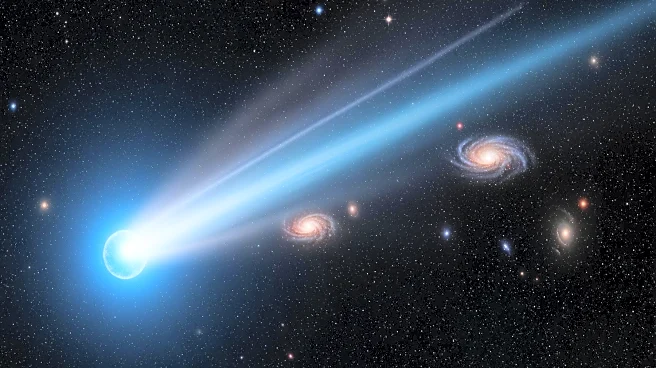
Comet 3I/ATLAS, the third confirmed interstellar object to visit our solar system, is captivating scientists and the public alike with its unique characteristics. Unlike typical solar system comets, 3I/ATLAS originated from beyond our solar system, making
its trajectory and composition subjects of intense study. Observations from NASA and international telescopes have revealed that the comet emits unusually high levels of methanol, hydrogen cyanide, and carbon dioxide. Additionally, the MeerKAT radio telescope detected natural radio absorption features, which some speculated could indicate alien technology, though experts have clarified these are natural phenomena. The comet's passage offers a rare opportunity to study interstellar material and its potential to unlock secrets about the formation of planetary systems.
Why It's Important?
The arrival of Comet 3I/ATLAS provides a unique opportunity for scientists to study an interstellar object in detail, potentially offering insights into the building blocks of other planetary systems. Its unusual chemical composition challenges existing theories about comet formation and behavior, prompting further research into the diversity of cosmic bodies. The comet's presence also fuels public interest in astronomy, highlighting the importance of continued investment in space exploration and research. While some speculate about its origins, the scientific consensus remains that 3I/ATLAS is a natural object, underscoring the need for careful analysis and skepticism in the face of extraordinary claims.
What's Next?
As Comet 3I/ATLAS continues its journey through the solar system, astronomers will use telescopes like the James Webb Space Telescope to monitor changes in its composition and behavior. This ongoing study aims to enhance our understanding of interstellar objects and their interactions with solar environments. The data collected will contribute to broader efforts to map the diversity of cosmic bodies and their potential impact on our understanding of the universe. Public interest in the comet may also inspire educational initiatives and outreach programs to engage more people in the wonders of space science.