


What's Happening?
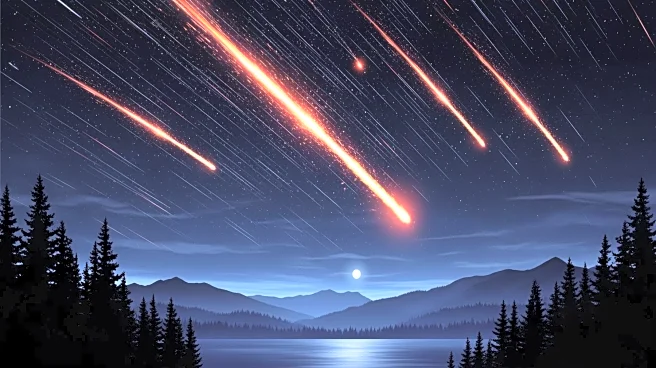
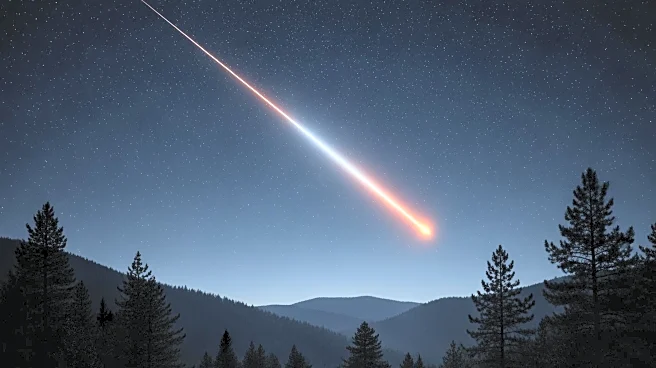
A bright green meteor, described as a fireball, was captured on a dashcam video as it streaked across the sky in the Pacific Northwest. The event occurred at 6:06 a.m. on a Monday morning, witnessed by Jason Jenkins while driving in southwestern Washington
state, approximately 20 miles north of Portland, Oregon. Initially mistaken for a comet, the meteor was later identified as a fireball, a particularly bright meteor visible up to 80 miles above the Earth. The Oregon Museum of Science and Industry explained that the green color is often due to magnesium, which emits a bright blue-green light when vaporized in the atmosphere. The meteor's visibility was enhanced by its altitude in the dark early morning sky.
Why It's Important?
The sighting of such a meteor is significant as it highlights the natural phenomena that can be observed with the increasing prevalence of dashcams and other recording devices. These devices have made it easier to capture and report such events, contributing to scientific understanding and public interest in astronomy. The event also underscores the rarity and spectacle of fireballs, which, despite their brightness, rarely make contact with the Earth's surface. When they do, they can be difficult to locate unless they cause noticeable damage or leave debris.
What's Next?
With the video evidence and reports from other witnesses, there may be efforts to determine the meteor's trajectory and whether any fragments reached the Earth's surface. Such investigations could involve collaboration between local scientific institutions and amateur astronomers. The increased documentation of these events could lead to more comprehensive data collection and analysis, enhancing our understanding of meteoric activity.
Beyond the Headlines
The event reflects a broader trend of increased public engagement with astronomical phenomena, facilitated by technology. As more people equip their vehicles and homes with cameras, the documentation of such events is likely to increase, providing valuable data for scientific research. This trend also raises questions about privacy and the use of personal recording devices in public spaces.