




What's Happening?
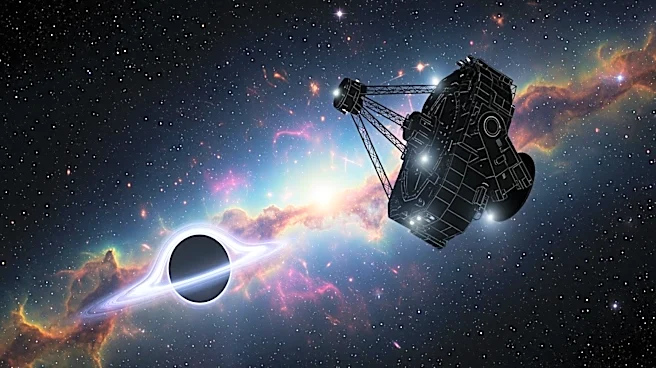
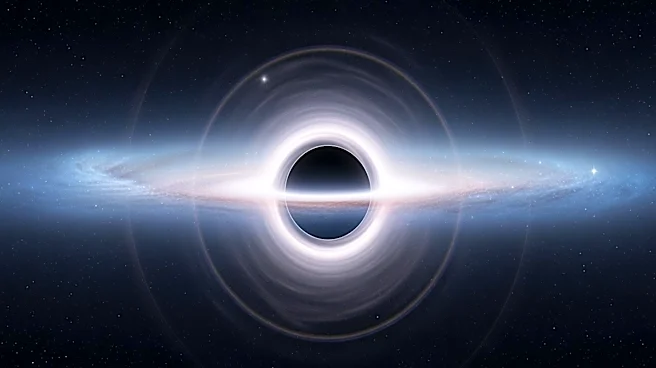
A team of astronomers led by Renee Key from Swinburne University of Technology has identified a potential primordial black hole, named Phoebe, in the Milky Way's halo. This discovery was made after observing a distant star's brightness flare for about
an hour, a phenomenon that did not match any known stellar activity. The team suggests that Phoebe, which is about three times the mass of the Moon, could be a primordial black hole, a theoretical type of black hole formed shortly after the Big Bang. These black holes are difficult to detect due to their small size and the faintness of their gravitational effects. The event was recorded by the Dark Energy Camera in 2019, and the findings have been published on arXiv.
Why It's Important?
The identification of Phoebe as a potential primordial black hole could have significant implications for our understanding of dark matter and the early universe. Primordial black holes are theorized to be remnants from the Big Bang and could provide insights into the distribution of dark matter in the Milky Way. This discovery also contributes to ongoing debates in the astronomical community about the existence and detection of such black holes. If confirmed, Phoebe could open new avenues for research into the physics of inflation and the conditions of the early universe.
What's Next?
Further observations and more sensitive telescopes are needed to confirm Phoebe's status as a primordial black hole. The team suggests that upcoming microlensing programs at the Roman and Vera C. Rubin Observatories could enhance the detection of low-mass microlenses like Phoebe. This discovery also encourages the re-evaluation of previous microlensing events that might have been overlooked or misclassified. The ongoing debate about the nature of these events will likely continue, with more data needed to reach a consensus.