


What's Happening?
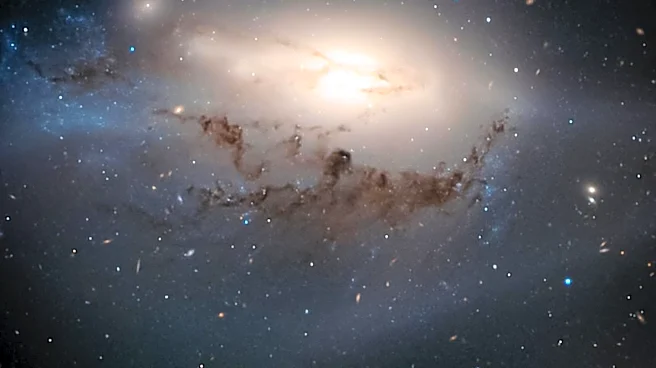
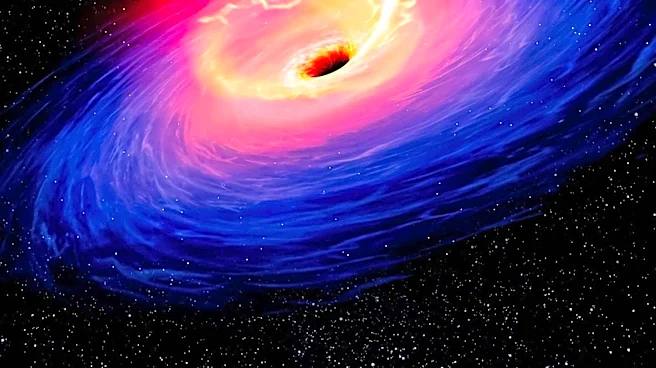
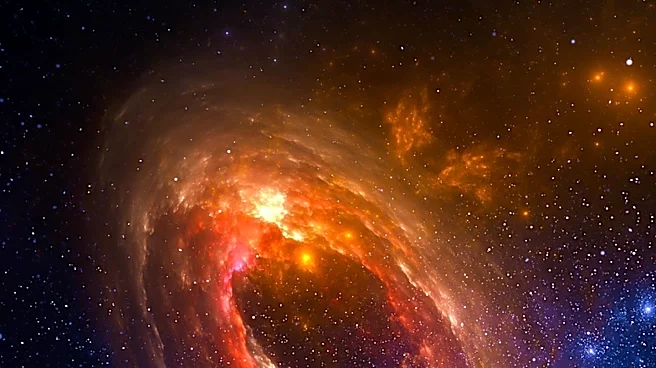
NASA's Chandra X-ray spacecraft has observed a supermassive black hole impacting a galaxy known as the 'red potato,' located approximately 11.7 billion light-years from Earth. This galaxy, officially designated MQN01 J004131.9-493704, was initially discovered
by the James Webb Space Telescope. The galaxy's peculiar nickname stems from its odd, blob-like appearance. The black hole is churning and heating the surrounding gas, preventing it from cooling and forming new stars. This discovery was led by Weichen Wang from the University of Milan-Bicocca, who noted that the black hole's jet is stirring the gas, slowing the galaxy's ability to form new stars.
Why It's Important?
This observation is significant as it provides insights into the behavior of gas around non-star-forming galaxies and the role of supermassive black holes in galaxy evolution. The findings suggest that the black hole's activity could be a factor in the galaxy's inability to form new stars, offering a new perspective on how galaxies interact and evolve. This research could help astronomers understand the complex dynamics of galaxy formation and the influence of black holes on their environments.
What's Next?
Further research is likely to focus on understanding the broader implications of these findings for galaxy formation theories. Scientists may investigate other galaxies with similar characteristics to determine if this phenomenon is common. The study could also lead to new models of galaxy evolution that incorporate the effects of supermassive black holes.