







What's Happening?
A town hall meeting hosted by NO765MN in Preston, Minnesota, revealed significant public opposition to a proposed 765 kV transmission line. The project, intended to extend from the South Dakota border across southern Minnesota to Wisconsin, includes a 139-mile
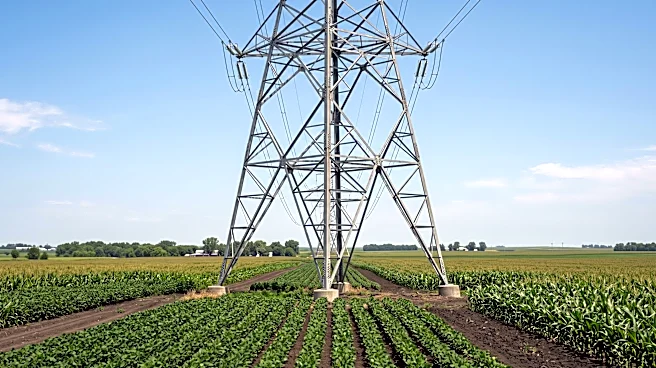
segment known as the Gopher-Badger Link. Opponents, including farmers, landowners, and local governments, believe the line is primarily designed to power a proposed Google data center near Pine Island, rather than serving local Minnesota homes. Xcel Energy and Dairyland Power, however, maintain that the 765 kV line is part of a regional transmission plan developed by the Midcontinent Independent System Operator (MISO) to strengthen the regional grid. The proposed line would require 250-foot right-of-ways and 150- to 200-foot steel lattice towers installed every 1,000-1,500 feet, with concrete piers drilled up to 50 feet deep.
Why It's Important?
This proposed transmission line project highlights a growing conflict between energy infrastructure development and local community concerns. The scale of the 765 kV line, which would be the highest voltage in the upper Midwest, raises significant environmental, health, and aesthetic concerns for residents. Landowners are particularly worried about the impact on property values, the disruption to agricultural land, and potential health risks from electromagnetic fields (EMF) and noise. The debate also underscores the tension between regional energy needs, often driven by large-scale industrial consumers like data centers, and the specific impacts on local communities. The requirement for a 'certificate of need' from the Minnesota Public Utilities Commission (PUC) before construction can begin provides a critical regulatory hurdle, emphasizing the importance of public input and scientific review in such large-scale infrastructure projects.
What's Next?
Opponents are urging the Minnesota Public Utilities Commission (PUC) to deny the 'certificate of need' for the project, arguing that the utilities have not adequately demonstrated its necessity or safety. They are advocating for a study of 765 kV lines and suggesting alternatives like burying the line underground using High-Voltage Direct Current architecture to mitigate health and environmental concerns. Concerned citizens are encouraged to engage with NO765MN, write to the Minnesota PUC, and donate to the cause. The PUC's decision will be crucial, as it will determine whether the project can proceed and under what conditions. This process will likely involve further public hearings, expert testimonies, and detailed environmental impact assessments, with significant lobbying from both proponents and opponents of the transmission line.
Beyond the Headlines
The controversy surrounding the 765 kV transmission line reflects broader national challenges in energy policy and infrastructure development. As the demand for electricity grows, particularly from energy-intensive industries like data centers, the need for robust transmission infrastructure becomes more pressing. However, this often clashes with local environmental protection, public health concerns, and property rights. The debate over overhead versus underground lines, and the associated costs and benefits, is a recurring theme in such projects. This case also highlights the power of grassroots movements in influencing major infrastructure decisions and the importance of regulatory bodies in balancing economic development with community well-being. The outcome in Minnesota could set precedents for similar projects across the U.S., influencing how future energy needs are met while addressing local impacts.