
What's Happening?
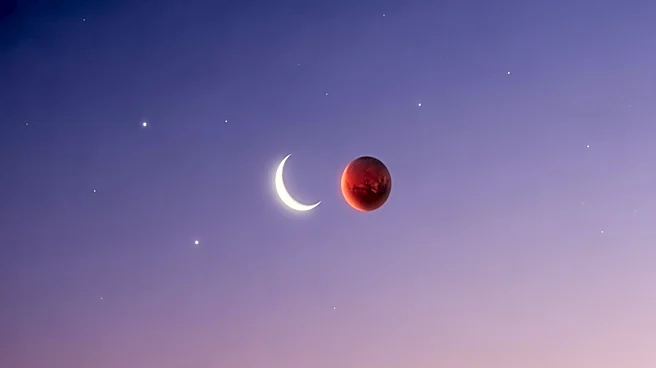
On May 14, 2026, sky watchers in the U.S. will have the opportunity to observe a celestial event featuring Mars and the Moon. The Red Planet will be visible in the early morning sky, positioned just 7
degrees from a delicate crescent Moon. This event occurs shortly before sunrise, providing a brief window for observation. Mars, with a magnitude of 1.3, will appear low in the sky, just over 1 degree high an hour before sunrise. Observers are advised to look east about an hour before sunrise for the best view, especially from a location with a clear horizon. Binoculars or small telescopes are recommended to enhance visibility. The Moon will pass 5 degrees due north of Mars at 9 P.M. EDT, adding to the spectacle.
Why It's Important?
This celestial event is significant for both amateur and professional astronomers as it offers a rare opportunity to observe Mars in conjunction with the Moon. Such events are not only visually striking but also provide valuable opportunities for educational outreach and public engagement in astronomy. Observing Mars, a planet of great interest due to its potential for past life and future human exploration, alongside the Moon, can inspire interest in space science and exploration. Additionally, these events can foster a greater appreciation for the night sky and the natural world, encouraging more people to engage in stargazing and learn about astronomy.
What's Next?
Following this event, astronomy enthusiasts can look forward to more celestial occurrences throughout the year. The visibility of Mars will improve as it rises higher in the sky in the coming months. Observers can also anticipate other planetary conjunctions and meteor showers, which are popular events for both casual observers and seasoned astronomers. These events provide ongoing opportunities for public engagement and education in astronomy, as well as for scientific observation and study.