




What's Happening?
A series of significant Eurasian security meetings recently concluded in Moscow and Minsk, setting a backdrop for ongoing discussions in Abu Dhabi concerning the Ukraine conflict. The 4th Minsk International Conference on Eurasian Security, held from
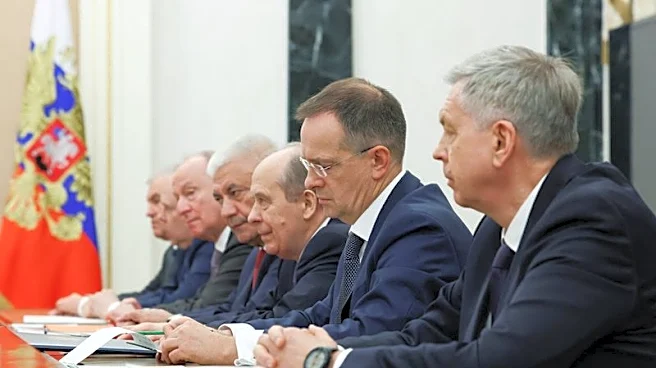
November 3-4, gathered over 800 participants from 50 countries, including representatives from the Shanghai Cooperation Organisation (SCO), the Organization for Security and Co-operation in Europe (OSCE), the Commonwealth of Independent States (CIS), and the Collective Security Treaty Organisation (CSTO). Concurrently, a joint meeting of the CSTO Council of Foreign Ministers, Council of Defence Ministers, and Committee of Secretaries of Security Councils took place in Moscow on November 10. These meetings focused on developing a new Eurasian security architecture based on principles of equal and indivisible security, addressing military-political security, arms control, emerging technologies, and economic cooperation. Belarus President Aleksandr Lukashenko participated in the Minsk conference, and Russian Foreign Minister Sergey Lavrov chaired the CSTO meeting.
Why It's Important?
These Eurasian security discussions are crucial as they aim to establish a comprehensive security framework that extends beyond the immediate European context, encompassing the entire Eurasian continent. The emphasis on 'equal and indivisible security' suggests a move away from existing security models that participants believe failed to prevent the current conflict. The outcomes of these meetings, particularly the consensus among CSTO members and Minsk conference attendees, are expected to influence the ongoing Abu Dhabi talks regarding a resolution to the Ukraine conflict and the drafting of a new European security architecture. The involvement of various regional organizations underscores a collective effort to manage conflict risks, foster inclusive dialogue, and develop mechanisms for mutual military notifications, which are vital for long-term stability in the region. The discussions also highlight the broader impact of the Ukraine conflict on Eurasia, not just Europe.
What's Next?
The insights and agreements from the Minsk and Moscow security meetings will likely inform the positions of participating nations in the ongoing Abu Dhabi talks concerning Ukraine. While specific details of the discussions are not publicly released due to their sensitive nature, the focus on a new security architecture suggests that proposals for de-escalation, conflict prevention, and regional stability will be put forth. Future diplomatic engagements are expected to build upon these foundational discussions, aiming to translate the principles of equal and indivisible security into actionable policies. The next meeting of the CSTO Council of Foreign Ministers is scheduled for the first half of 2027 in Tajikistan, indicating continued efforts to address security concerns, particularly in Eastern Eurasia and along Afghanistan's borders.
Beyond the Headlines
The coordinated security discussions in Minsk and Moscow reflect a growing desire among Eurasian nations to assert their collective interests in shaping regional and global security paradigms. This push for a new security architecture could challenge existing international norms and institutions, potentially leading to a re-evaluation of geopolitical alliances and power balances. The emphasis on countering disinformation, ensuring human control over AI, and lifting unilateral coercive measures points to a broader agenda that extends beyond traditional military security to include technological and economic dimensions. The absence of Armenia from the CSTO meeting, despite its membership, also signals potential internal dynamics and differing national interests within the alliance, which could impact future collective security efforts. These developments suggest a complex and evolving geopolitical landscape in Eurasia, with significant implications for global stability.