


What's Happening?
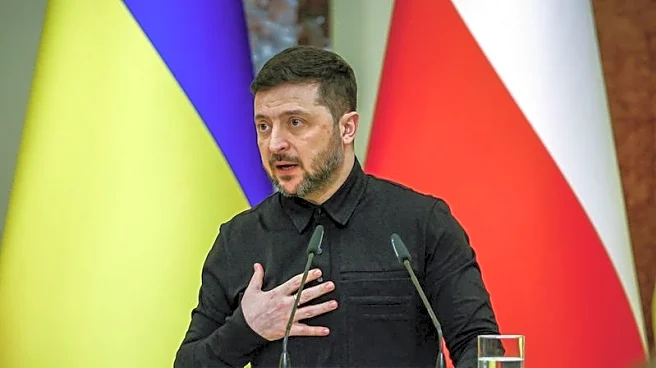
Russia has reacted to Ukrainian President Volodymyr Zelensky's decision to drop Kyiv's demand to join NATO, a move seen as a significant shift in the ongoing peace negotiations between the two countries. Dmitry Peskov, the spokesman for Russian President Vladimir
Putin, emphasized that the issue of NATO membership is a cornerstone of the peace talks. Russia views NATO's expansion as a major security threat, while Ukraine's pursuit of membership has been driven by fears of Russian aggression. Despite dropping the NATO bid, Zelensky is seeking strong security guarantees to deter future Russian actions. Discussions include the potential deployment of Western peacekeeping troops in Ukraine, a proposal opposed by the Kremlin, which considers such troops as legitimate targets. The European Union's top diplomat, Kaja Kallas, stressed the need for tangible security guarantees for Ukraine.
Why It's Important?
The decision by Ukraine to abandon its NATO membership pursuit marks a pivotal moment in the peace negotiations with Russia. This move could potentially ease tensions and open pathways to a peace agreement, impacting regional stability and security dynamics in Eastern Europe. For the U.S. and its allies, this development could alter strategic military and diplomatic engagements in the region. The shift also highlights the complex balance of power and the influence of international alliances on national security policies. The outcome of these negotiations could set precedents for how similar conflicts are managed globally, affecting international relations and security frameworks.
What's Next?
As the peace talks progress, the focus will likely shift to securing concrete security guarantees for Ukraine. The potential deployment of Western peacekeeping forces remains a contentious issue, with Russia's opposition posing a significant challenge. The international community, including the U.S. and EU, may need to negotiate terms that ensure Ukraine's security without escalating tensions with Russia. The outcome of these discussions could influence future NATO policies and the geopolitical landscape in Eastern Europe. Stakeholders will be closely monitoring the situation, as any agreements reached could have far-reaching implications for regional and global security.