
What's Happening?
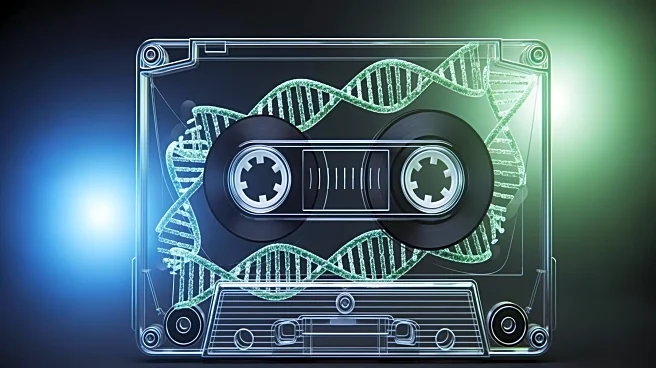
Researchers at the Southern University of Science and Technology in Guangdong, China, have developed a groundbreaking cassette tape that utilizes DNA to store data. This innovative technology can hold
up to 36 petabytes of information, equivalent to 36,000 terabyte hard drives, on a single tape. The DNA cassette tape can store any digital file type, including text, images, audio, and video. The team, led by Xingyu Jiang, created the tape by printing synthetic DNA molecules onto a plastic tape, allowing the sequence of DNA bases to represent digital information. This development has sparked interest across various fields, inspiring new ways of thinking about data storage and technology.
Why It's Important?
The introduction of DNA-based data storage could revolutionize the way information is stored and accessed, offering a solution to the growing demand for data storage capacity. This technology has the potential to significantly reduce the physical space required for data storage, as DNA can store vast amounts of information in a compact form. The implications for industries reliant on large-scale data storage, such as cloud computing, media, and scientific research, are substantial. By providing a more efficient and sustainable method of data storage, this innovation could lead to cost savings and environmental benefits, as well as drive further advancements in data technology.
What's Next?
The research team plans to develop a new read-write head for the DNA cassette, similar to those used in traditional magnetic tape drives. This component will enable precise positioning and processing of the DNA tape for reading, writing, and rewriting data. The team aims to bring the DNA cassette tape to market within five years, potentially transforming the data storage industry. As the technology progresses, it is likely to attract interest from tech companies and investors looking to capitalize on its potential. The success of this project could pave the way for further innovations in DNA-based technologies.