What's Happening?
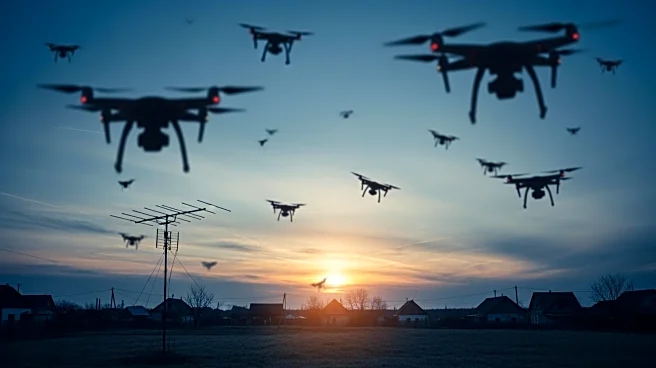
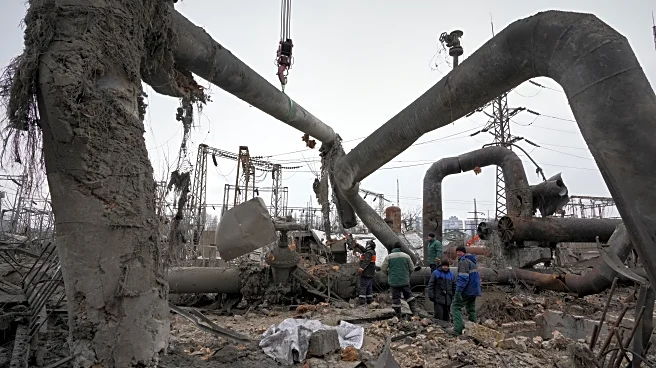
Ukraine is rapidly deploying low-cost interceptor drones to counter Russia's evolving aerial attacks on cities and power infrastructure. These interceptors, such as the Sting and Bullet, are designed to effectively
counter fast-evolving Russian suicide drones, which are now flying faster and at higher altitudes. The interceptors are part of a broader strategy to rewrite air defense protocols, focusing on mass production and rapid adaptation. Ukrainian drone makers are also set to expand coproduction with U.S. and European firms, merging battle-tested designs with Western scale and funding. This collaboration aims to boost output and integrate Ukraine into NATO-member supply chains.
Why It's Important?
The deployment of cost-effective drone interceptors is crucial for Ukraine's defense strategy, as it allows for a scalable and economically viable solution to counter Russian aerial threats. These interceptors realign the cost and scale equation of air defense, providing a cornerstone for modern counter-unmanned aerial systems. The collaboration with U.S. and European firms not only enhances production capabilities but also strengthens Ukraine's ties with NATO, potentially leading to more robust defense systems. The economic impact is significant, as the interceptors destroy drones that cost significantly more, inflicting economic damage on the adversary.
What's Next?
Ukraine and NATO are expected to continue the hyper-scaling of drone production, adding urgency to European plans to create a layered air-defense system known as the 'drone wall.' This network, to be rolled out over two years, is designed to detect, track, and intercept drones, with Ukrainian-style interceptors playing a central role. The collaboration with Western firms is likely to expand, embedding Ukraine further into NATO supply chains. Additionally, there is a push towards increased automation, with drones potentially becoming fully autonomous to enhance soldier safety.
Beyond the Headlines
The development and deployment of these interceptors highlight a shift in modern warfare, where cost-effective and rapidly adaptable solutions are prioritized. The integration of Ukrainian designs into NATO supply chains could lead to long-term shifts in defense strategies and alliances. The focus on automation and artificial intelligence in drone technology also raises ethical and strategic considerations, as these technologies become more autonomous and potentially more influential in military operations.