





What's Happening?
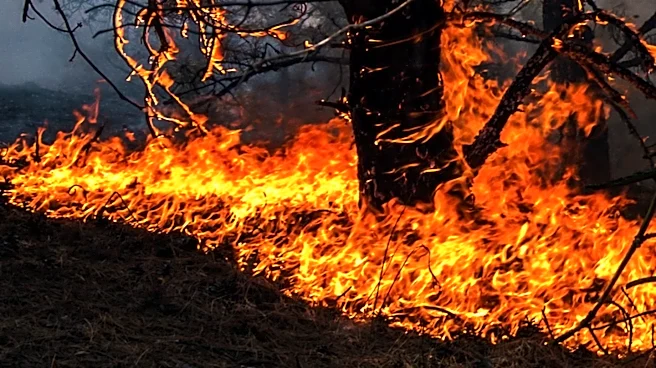
A new study indicates that the number of U.S. structures damaged or destroyed by wildfires is on track to nearly triple by mid-century, potentially leading to the loss of up to 449,000 buildings between 2026 and 2060. This projection is based on an analysis
that combines historical development patterns, wildfire data, and future climate and housing-density expectations. The research highlights that rising temperatures, driven by human activities like burning fossil fuels, are increasing the rate at which the atmosphere dries out soils and vegetation, significantly extending the fire season. Furthermore, increased human development in and around wildland areas is placing more people and buildings in harm's way, while also introducing more ignition sources. The western U.S. is expected to see the most pronounced rise in burned area, with annual figures potentially tripling. However, the Central U.S. is also projected to experience substantial increases, and even parts of the South and East could see shifts in fire activity, challenging traditional perceptions of risk.
Why It's Important?
This projected increase in wildfire damage carries significant implications for U.S. communities, infrastructure, and the economy. The potential loss of hundreds of thousands of structures will lead to immense financial burdens for homeowners, insurance companies, and government disaster relief agencies. It also poses a severe threat to public safety, with increased risks of fatalities, injuries, and widespread displacement. The study also points out that roughly one-third of western neighborhoods facing the greatest future risk are low-income communities. These communities often lack the resources to implement protective measures, maintain adequate insurance, or recover financially after a fire, exacerbating existing socioeconomic disparities. The growing threat also puts pressure on public policy to adapt, requiring more robust fire prevention strategies, updated building codes, and improved land-use planning to mitigate future losses and protect vulnerable populations.
What's Next?
Addressing the escalating wildfire risk will require a multi-faceted approach involving various stakeholders. Policymakers may need to consider implementing stricter building codes for new constructions in fire-prone areas, promoting fire-resistant materials, and investing in community-level mitigation programs. Utilities will likely face increased pressure to harden their infrastructure to prevent ignitions, potentially leading to higher costs for consumers. Insurance companies may adjust premiums or coverage in high-risk zones, impacting affordability and availability for residents. Furthermore, there will be a continued focus on forest management practices, including prescribed burns and thinning operations, to reduce fuel loads. Public awareness campaigns will also be crucial to educate homeowners on actions they can take to protect their properties, such as creating defensible spaces and using ember-resistant vents. The effectiveness of these measures will depend on coordinated efforts across federal, state, and local levels, as well as private sector and community engagement.
Beyond the Headlines
The escalating wildfire crisis extends beyond immediate property damage, touching upon deeper ethical, legal, and cultural dimensions. Ethically, there's a growing debate about the responsibility of developers, local governments, and individuals in building and residing in high-risk areas, especially as climate change intensifies these threats. Legally, there could be increased litigation against utilities for fire ignitions and against local authorities for inadequate land-use planning or failure to enforce safety standards. Culturally, the traditional relationship between communities and their natural landscapes is being redefined, as fire, once a natural process, becomes an increasingly destructive force due to human influence and climate change. This shift may necessitate a re-evaluation of how communities interact with wildlands, potentially leading to new norms around development, resource management, and disaster preparedness. The long-term implications also include potential shifts in population distribution as some areas become uninsurable or too dangerous to inhabit, leading to internal migration and new pressures on less fire-prone regions.