







What's Happening?
Spain's national intelligence agency issued multiple warnings about a potential mass crossing of migrants from Morocco into the Spanish exclave of Ceuta in late July, according to declassified documents released by the Spanish government. These documents,
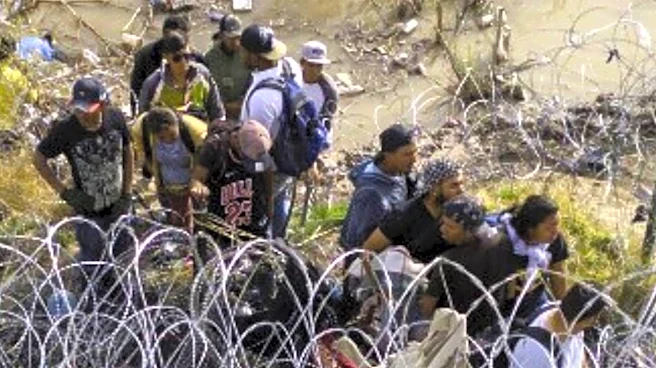
a trove of 40 alerts, intelligence reports, charts, and communications, appear to contradict Spanish Prime Minister Pedro Sánchez's previous statements regarding the level of prior warning. On July 29, a day before the influx, the National Intelligence Center (CNI) sent an alert via WhatsApp to the Spanish government's delegation in Ceuta, detailing calls on social media for an 'assault on the fence and by sea.' The message noted two social media groups with a total of 180,000 followers encouraging these attempts. Similar warnings were sent to Spain's Civil Guard police force and Moroccan intelligence agencies, mentioning that migrants might exploit Morocco's national Throne Day on July 30.
Why It's Important?
The declassification of these documents is significant as it raises questions about the Spanish government's preparedness and response to the Ceuta border crisis. Prime Minister Sánchez has maintained that the documents did not indicate the scale of the crisis that unfolded, stating that while the 'campaign' was known and monitored, it did not constitute an indicator of the eventual magnitude. However, the detailed warnings from the CNI, including the mention of 180,000 social media followers, suggest a more substantial foreknowledge than previously acknowledged. This discrepancy has fueled criticism from opposition parties, who accuse the government of failing to act despite being alerted. The crisis resulted in thousands of migrants entering Ceuta, leading to a prolonged humanitarian situation and raising concerns about border security and international cooperation.
What's Next?
The release of these declassified documents is likely to intensify political scrutiny and debate within Spain regarding the government's handling of the Ceuta border crisis. Opposition parties are expected to continue pressing for accountability and further investigations into why the warnings were seemingly downplayed or not acted upon more decisively. The ongoing humanitarian crisis in Ceuta, with thousands of migrants still in the city, will require continued attention and resources. Furthermore, the incident could prompt a re-evaluation of intelligence sharing protocols and border security measures between Spain and Morocco, as well as within the European Union, especially given the EU's commitment to combating illegal migration and bolstering external borders.
Beyond the Headlines
Beyond the immediate political fallout, the Ceuta border crisis and the subsequent declassification of intelligence documents highlight deeper issues concerning migration, national sovereignty, and international relations. The incident underscores the complex challenges faced by European nations in managing irregular migration flows and the delicate balance between humanitarian concerns and border control. The alleged 'negligent and passive' behavior of Moroccan forces, as noted in a Defense Ministry intelligence report, also points to potential geopolitical tensions and the use of migration as a leverage point in international diplomacy. This event could trigger broader discussions on the ethical responsibilities of states in preventing mass crossings, the role of social media in organizing such movements, and the need for more robust, coordinated responses to humanitarian crises at borders.